DESIGN · BUILD · AUTOMATE
CHERRY HILLS VILLAGE SERVICES
EV Charger Install — Level 2 in Cherry Hills Village
Licensed EV charger install — level 2 services for Cherry Hills Village and Arapahoe County. Charge at home. Every night..
What Cherry Hills Village requires
Code reference: ### Exempt Work (Cherry Hills Village Municipal Code Section 105.2, referencing adopted I-Codes) §105.2
See full local requirements ↓- Full Design Lifecycle
- Construction & Tenant Finish
- Smart Home · A/V · Edge Compute
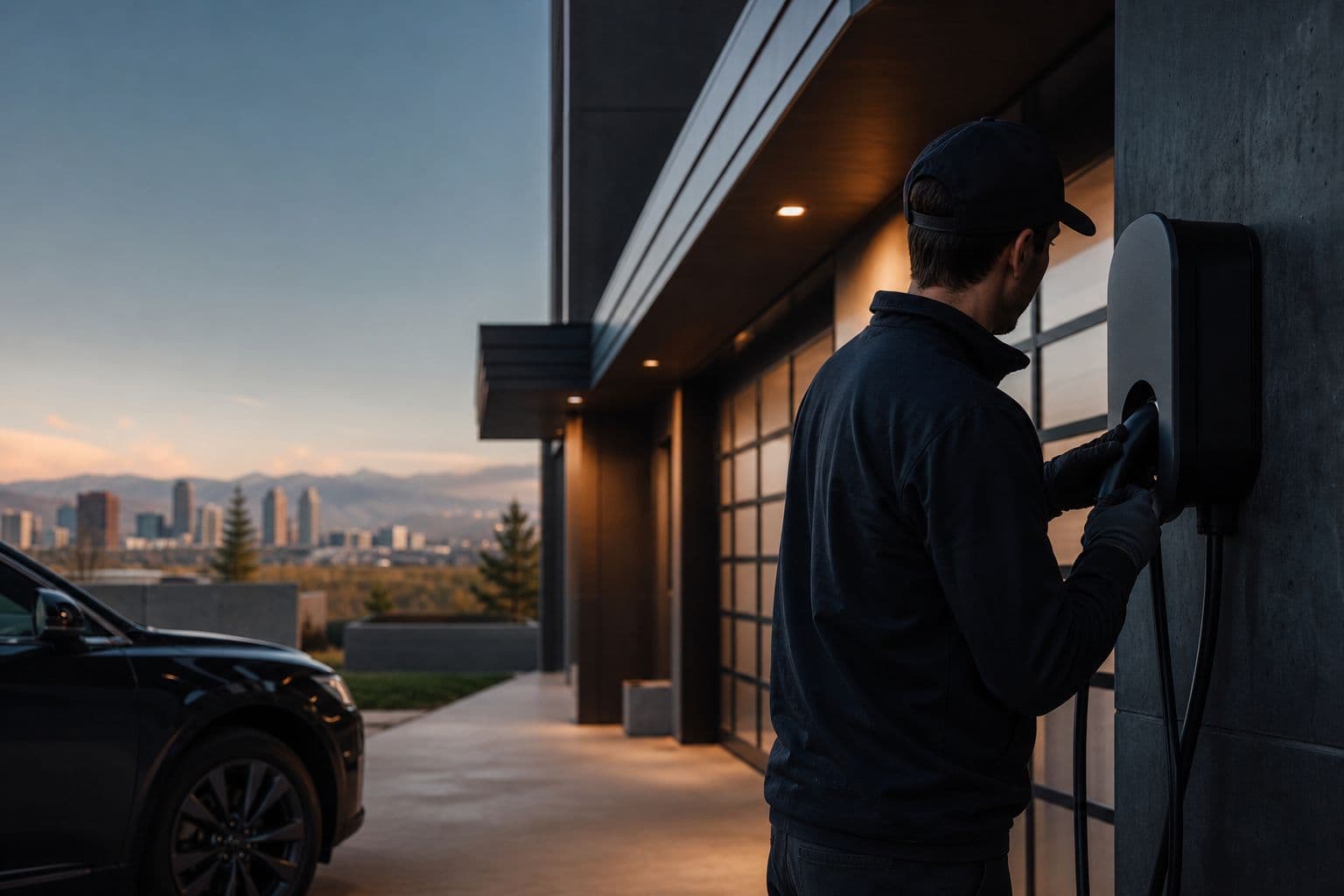
Charge at home. Every night.
FREE PLANNING TOOLS
Both tools are free and take a couple of minutes — start in either one.
EVERY PROJECT STARTS WITH DESIGN
Local Service
EV Charger Install — Level 2 Services in Cherry Hills Village, Colorado
Autotelic provides professional EV charger install — level 2 services throughout Cherry Hills Village and the surrounding Arapahoe County area. Level 2 EV charger installation across the Denver metro by a Tesla Certified Installer — Tesla Wall Connector and universal J1772/NACS units. We run a panel-capacity check and load calculation before quoting, then install a dedicated 240V circuit for garage or weather-rated exterior mounting. The municipal permit, inspection, and load-management setup for multi-EV homes are handled under one electrical scope. Whether you're in Cherry Hills Village (affluent south Denver) or nearby communities, our team delivers quality workmanship backed by Colorado licensing and full insurance coverage.
The build sequence for a EV Charger Install — Level 2 project
This service is a component of How a Home remodel project works in Cherry Hills Village.
- First contact for a EV Charger Install — Level 2 project
- EV Charger Install — Level 2 feasibility in Cherry Hills Village
- How a EV Charger Install — Level 2 project is estimated
- Designing a EV Charger Install — Level 2 project
- Managing a EV Charger Install — Level 2 job in the client portal
- On site: the crew app
Permit Thresholds
Cherry Hills Village permit thresholds
- Code reference
- The Village adopted the 2024 International Codes (I-Codes) at the beginning of 2026, including the 2024 International Residential Code (IRC), and adheres to Chapter 18 of the Cherry Hills Village Municipal Code for building regulations.
- Code reference
- If an addition is more than 50% of the existing square footage, or if the aggregate floor area is demolished or reconstructed by more than 50%, or increased by 50% or more, the project is considered "redevelopment" and may have additional submittal and drainage requirements per Chapter 9 of the zoni
- Code reference
- Any electrical work on 400 amps (320 continuous) or greater requires a separate plan review.
- Impervious Surface
- If more than 2,500 square feet of impervious surface is added cumulatively (e.g., house addition, driveway, patio), a Phase III Drainage Plan is required.
- Code Reference
- Cherry Hills Village Municipal Code, Chapter 18, and the adopted 2024 International Residential Code.
- Code reference
- ### Exempt Work (Cherry Hills Village Municipal Code Section 105.2, referencing adopted I-Codes)§105.2
- Code reference
- One-story detached, prefabricated storage sheds that do not exceed 120 square feet.
- Code Reference
- Cherry Hills Village Municipal Code, Section 105.2, referencing adopted I-Codes.§105.2
Codes are amended regularly — verify current requirements with **The City of Cherry Hills Village (specifically its Building Division under Community Development) issues residential building permits.
Energy Code
Cherry Hills Village energy code quick facts
- Code reference
- Cherry Hills Village, Colorado, has adopted the 2024 International Energy Conservation Code (IECC).
- Code reference
- However, state law requires local jurisdictions to adopt and enforce the 2021 International Energy Conservation Code (IECC) and the Colorado Model Electric Ready and Solar Ready Code when updating any other building code, with amendments not permitted to decrease effectiveness or energy efficiency.
- Code reference
- An ordinance (Ordinance No. 2023, Series 1) also indicates the adoption of the 2021 International Energy Conservation Code.Ord. No. 2023
- Code reference
- Cherry Hills Village is located in IECC Climate Zone 5B.
- Code reference
- The following are key prescriptive requirements for residential remodels and additions, based on the 2021 IECC for Climate Zone 5B, which serve as minimum standards under the adopted energy code:
- Code reference
- ### Key Prescriptive Requirements for Remodels/Additions (2021 IECC, Climate Zone 5B)
- Requirement
- R-49 minimum, with an R-60 retrofit recommended.
- Code reference
- The 2021 IECC raised the prescriptive ceiling to R-60, with R-49 acceptable only with a raised-heel truss (per IECC R402.2.1).
Codes are amended regularly — verify current requirements with **The City of Cherry Hills Village (specifically its Building Division under Community Development) issues residential building permits.
text
What this covers
Level 2 AC charger at a residence or small commercial stall, on a dedicated circuit. Panel capacity, run length, and indoor/outdoor rating are checked before gear is ordered.
text
Technical scope
Level 2 AC charger at a residence or small commercial stall, on a dedicated circuit. Panel capacity, run length, and indoor/outdoor rating are checked before gear is ordered. A municipally licensed Denver general contractor coordinates specialty trades for the circuit and charger.
text
How the work is coordinated
A municipally licensed Denver general contractor coordinates specialty trades for the circuit and charger. Denver-metro work is permitted locally. Colorado has no statewide general-contractor license. Cities and counties license general contractors. DORA licenses electrical and plumbing (and similar regulated trades), not general contractors. Autotelic is a municipally licensed Denver general contractor that coordinates licensed specialty trades. Denver building permits run through Community Planning and Development (CPD). Costs are project-specific; no dollar figures.
Service Area
Serving Cherry Hills Village and Arapahoe County
We serve Cherry Hills Village, CO and all surrounding Denver metro communities. Our team is based in Denver and operates throughout the Front Range, from Castle Rock to Longmont and everywhere in between. Contact us for a free estimate on your Cherry Hills Village project.
FAQ
Common questions
Do I need a panel upgrade for a Level 2 charger?
Often no. We run a load calculation on your existing panel before quoting. If your service has headroom, a dedicated 240V circuit fits without an upgrade. If the load is tight, load management can delay or avoid a 200A upgrade; we only recommend an upgrade when the math actually requires it.
Should I choose the Tesla Wall Connector or a universal charger?
The Tesla Wall Connector is the cleanest fit for Tesla vehicles and is installed by our Tesla Certified Installer. Universal J1772 or NACS units suit households with mixed EV brands or drivers who want one charger for future vehicles. We match the hardware to what you drive now and expect to drive next.
Can you install a charger outside?
Yes. We mount chargers on garage interiors or weather-rated exterior locations, with conduit, enclosures, and hardware rated for Colorado sun, snow, and freeze-thaw. The install is permitted and inspected like any permanent electrical addition.
Do EV charger installs require a permit?
Yes — a Level 2 charger adds a dedicated 240V circuit, which requires a municipal electrical permit and inspection. We pull the permit and schedule the inspection as part of the project.
What if my household has more than one EV?
We plan for total charging load from the start. Load management shares the available capacity between vehicles, charges when demand is low, and keeps most homes off a costly panel upgrade. We size the circuit and settings for your current and expected fleet.
How It Runs
01
Survey
02
Design
03
Build
04
Verify
DESIGN SERVICES
Discovery & Site Analysis
Needs + preference programming, site survey, as-built documentation, feasibility.
We walk, measure, and photograph your property — existing conditions, utilities, structure, and constraints. You get the as-built documentation and feasibility read that every later decision rests on.
Learn more →Concept Design & Space Planning
Schematic design, floor plan studies, layout options.
Your scope becomes schematic floor plans you can compare side by side — circulation, daylight, adjacencies, and what each option does to the budget. Layout decisions happen on paper, where changes are cheap.
Learn more →Architectural Design & 3D Renderings
Design development, materials + finishes, photorealistic visualization.
The chosen concept resolves into materials, finishes, fixtures, and lighting — with the automation layer drawn in. Photorealistic renderings let you walk the space and adjust before anything is priced.
Learn more →Construction Documents & Permitting
Full CD sets, structural + MEP engineering coordination, permit-ready drawings.
Approved designs become coordinated architectural, structural, and MEP sheets — the set your jurisdiction permits from and trades build from. We submit, track, and answer review comments.
Learn more →CONSTRUCTION
New Construction & Custom Homes
Ground-up homes and light commercial, dirt to keys.
Ground-up residential and light commercial builds — foundations through finishes, including modular and steel construction. One accountable builder from dirt to keys.
Learn more →Remodels & Additions
Kitchens, baths, basements, pop-tops, whole-home.
Kitchens, baths, basements, pop-tops, and whole-home renovations that respect the house you already have. We handle structure, permits, and the dust.
Learn more →Commercial Tenant Finish & Build-Outs
Shells to working spaces — retail, office, restaurant, school.
Raw shells become working spaces — showrooms, offices, restaurants, schools. Dealer-spec finishes, code compliance, and opening dates held.
Learn more →ADUs & Modular Construction
Backyard cottages, garage conversions, factory-built homes.
Backyard cottages, garage conversions, and factory-built homes — zoning, design, permits, and set. Denver’s ADU rules are a specialty, not a surprise.
Learn more →Outdoor Living & Patio Structures
Decks, pergolas, and dining patios built for Colorado weather.
Decks, pergolas, and dining patios engineered for Colorado sun, snow, and hail — structure, shade, and drainage done right the first time.
Learn more →TECHNOLOGY
Smart Home Automation
Lighting, shades, climate, audio, security — one interface.
Whole-home control of lighting, shades, climate, audio, and security from a single interface — Crestron, Lutron, Savant, and Control4 designed in, not bolted on.
Learn more →A/V Systems
Theaters, distributed audio, video walls, commercial sound.
Theaters, distributed audio, video walls, and commercial sound — designed, installed, and tuned by the same team for over 20 years.
Learn more →Control Systems
Custom programming — scenes and schedules that fit the space.
Every subsystem brought into one elegant interface — custom programming for homes and venues, with scenes and schedules that match how the space is actually used.
Learn more →Networking & Edge Compute
Enterprise Wi-Fi, structured cabling, racks, on-prem compute.
Enterprise-grade Wi-Fi, structured cabling, racks, and on-premise compute — the backbone that makes everything else reliable, including our own Barbot platform.
Learn more →Solar & Energy Storage
Solar arrays, Tesla Powerwall, EV charging — certified install.
Solar arrays, Tesla Powerwall, and EV charging designed and installed by a Tesla Energy Certified team — roof, electrical, and app in one scope.
Learn more →Explore