DESIGN · BUILD · AUTOMATE
CHERRY HILLS VILLAGE SERVICES
Interior Painting in Cherry Hills Village
Paint Accent Wall, $245
See all 9 jobsLicensed interior painting services for Cherry Hills Village and Arapahoe County. Color and protection in every coat.
What Cherry Hills Village requires
Code reference: ### Exempt Work (Cherry Hills Village Municipal Code Section 105.2, referencing adopted I-Codes) §105.2
See full local requirements ↓- Full Design Lifecycle
- Construction & Tenant Finish
- Smart Home · A/V · Edge Compute
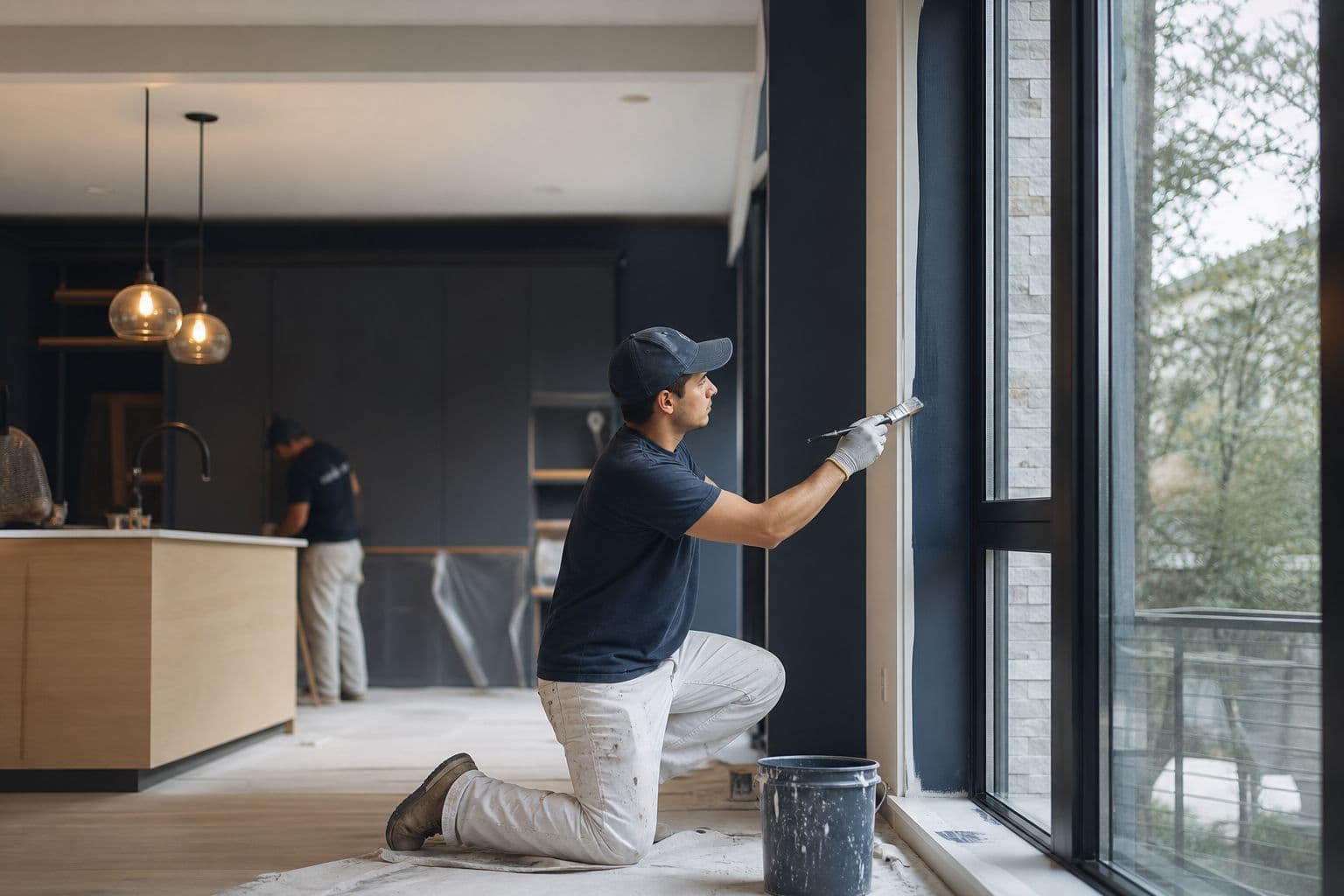
Color and protection in every coat
Jobs you can book online
Pick your job and choose a time.
Pay when you book. We confirm within 24 hours or refund you in full.
Fixed-price jobs
Paint Accent Wall
Paint one accent wall up to 12 ft wide x 9 ft tall: crisp taped edges at corners and ceiling, two coats in one color, masking included.
Pay when you book · morning (8–12) or afternoon (12–4)
What's included
Paint one accent wall up to 12 ft wide x 9 ft tall: crisp taped edges at corners and ceiling, two coats in one color, masking included. Paint included; on-site time includes dry time between coats. Excludes deep reds/oranges needing a third coat or tinted primer (small upcharge), specialty finishes (limewash, murals), walls over the size cap, and adjacent wall painting.
Paint One Room Ceiling
Paint one room ceiling up to 12x14 ft, height to 10 ft: mask walls/floor/fixtures, cut in, two coats flat ceiling white.
Pay when you book · morning (8–12) or afternoon (12–4)
What's included
Paint one room ceiling up to 12x14 ft, height to 10 ft: mask walls/floor/fixtures, cut in, two coats flat ceiling white. Paint included. Excludes popcorn/heavily textured ceilings that flake when rolled (see popcorn removal SKU), vaulted ceilings over 10 ft, water-stain sealing beyond one spot-prime, and wall painting.
Paint One Room, Walls Only - Large
Paint the walls of one large room up to 16x20 ft, ceilings to 10 ft (roughly 720 sq ft of wall): prep, cut in, two coats quality interior paint in one color, masking included.
Pay when you book · morning (8–12) or afternoon (12–4)
What's included
Paint the walls of one large room up to 16x20 ft, ceilings to 10 ft (roughly 720 sq ft of wall): prep, cut in, two coats quality interior paint in one color, masking included. Paint included. May be split into a TWO-VISIT job for coat dry time; duration shown is total on-site minutes. Excludes ceilings, trim, doors, two-story great-room walls, wallpaper removal, and drywall repair beyond minor filling.
Paint One Room, Walls Only - Medium
Paint the walls of one room up to 12x14 ft, 9 ft ceilings (roughly 470 sq ft of wall): light prep, cut in, two coats quality interior paint in one color, masking included.
Pay when you book · morning (8–12) or afternoon (12–4)
What's included
Paint the walls of one room up to 12x14 ft, 9 ft ceilings (roughly 470 sq ft of wall): light prep, cut in, two coats quality interior paint in one color, masking included. Paint included. Excludes ceilings, trim, doors, closet interiors, vaulted walls over 10 ft, wallpaper removal, primer coat for drastic color changes (small upcharge), and drywall repair beyond minor filling.
Paint One Room, Walls Only - Small
Paint the walls of one room up to 10x10 ft, 9 ft ceilings (roughly 320 sq ft of wall): light prep (nail holes, minor dings), cut in, two coats quality interior paint in one color, floors and fixtures masked.
Pay when you book · morning (8–12) or afternoon (12–4)
What's included
Paint the walls of one room up to 10x10 ft, 9 ft ceilings (roughly 320 sq ft of wall): light prep (nail holes, minor dings), cut in, two coats quality interior paint in one color, floors and fixtures masked. Paint included (standard sheens; customer picks color). Excludes ceilings, trim, doors, closets interiors, wallpaper removal, drastic color changes needing primer coat (small upcharge), and drywall repairs beyond minor filling.
Wallpaper Single Wall Hang (Customer-Supplied Paper)
Hang customer-supplied wallpaper on one wall up to 12 ft wide x 9 ft tall: wall prep (clean, minor fill, sizing/primer as needed), pattern-matched hang, trimmed edges, seams rolled.
Pay when you book · morning (8–12) or afternoon (12–4)
What's included
Hang customer-supplied wallpaper on one wall up to 12 ft wide x 9 ft tall: wall prep (clean, minor fill, sizing/primer as needed), pattern-matched hang, trimmed edges, seams rolled. Works with pasted, unpasted, and quality peel-and-stick papers. Customer must supply enough paper for the wall PLUS one extra roll for pattern match. Excludes paper material, wallpaper removal of existing paper (quoted separately), heavily textured walls requiring skim-coat first (see skim-coat SKU), and murals requiring exact centered layout beyond one focal alignment.
Priced per item
Paint Baseboard (Per Linear Foot)
$2.75 each · $2.25 each for 151+ · $89 minimum visit
Repaint existing baseboard: clean/scuff, caulk gaps at wall, tape floor line, two coats trim enamel.
Pay when you book · morning (8–12) or afternoon (12–4)
What's included
Repaint existing baseboard: clean/scuff, caulk gaps at wall, tape floor line, two coats trim enamel. Paint included. Duration typical for ~120 lf. Excludes stain-grade-to-paint conversion (bonding primer upcharge), carpet-edge protection beyond taped shield (fresh carpet at customer's risk), baseboard replacement (see install SKU), and wall paint touch-ups.
Paint Interior Door and Jamb (Per Door)
$115 each · $95 each for 5+ · $89 minimum visit
Paint interior doors both faces plus jamb and casing edges: degloss/scuff, mask hardware, brush-and-roll or spray two coats enamel.
Pay when you book · morning (8–12) or afternoon (12–4)
What's included
Paint interior doors both faces plus jamb and casing edges: degloss/scuff, mask hardware, brush-and-roll or spray two coats enamel. Paint included. TWO-VISIT job in most cases — first coats visit one, final coat after full dry on visit two; duration shown is total on-site minutes for a typical 3-door booking (add ~70 min per additional door). Excludes stain-to-paint conversions needing bonding primer on raw stain bleed (upcharge), French/panel-glass doors (masking upcharge), and hardware replacement.
Visit first, then quoted
Interior Painting Service Visit
$89 visit fee — credited toward the work
A painter walks the space, checks surface condition, and delivers a firm per-room or per-wall quote.
Pay when you book · morning (8–12) or afternoon (12–4)
What's included
A painter walks the space, checks surface condition, and delivers a firm per-room or per-wall quote. The $89 visit fee is credited toward your painting project.
FREE PLANNING TOOLS
Both tools are free and take a couple of minutes — start in either one.
EVERY PROJECT STARTS WITH DESIGN
Local Service
Interior Painting Services in Cherry Hills Village, Colorado
Autotelic provides professional interior painting services throughout Cherry Hills Village and the surrounding Arapahoe County area. Interior painting services across the Denver metro — walls, ceilings, trim, cabinets, and accent walls with thorough prep and premium paint products. Whether you're in Cherry Hills Village (affluent south Denver) or nearby communities, our team delivers quality workmanship, licensed and insured.
The build sequence for a Interior Painting project
Every project starts with a feasibility study; this trade is priced from the same assemblies.
Permit Thresholds
Cherry Hills Village permit thresholds
- Code reference
- The Village adopted the 2024 International Codes (I-Codes) at the beginning of 2026, including the 2024 International Residential Code (IRC), and adheres to Chapter 18 of the Cherry Hills Village Municipal Code for building regulations.
- Code reference
- If an addition is more than 50% of the existing square footage, or if the aggregate floor area is demolished or reconstructed by more than 50%, or increased by 50% or more, the project is considered "redevelopment" and may have additional submittal and drainage requirements per Chapter 9 of the zoni
- Code reference
- Any electrical work on 400 amps (320 continuous) or greater requires a separate plan review.
- Impervious Surface
- If more than 2,500 square feet of impervious surface is added cumulatively (e.g., house addition, driveway, patio), a Phase III Drainage Plan is required.
- Code Reference
- Cherry Hills Village Municipal Code, Chapter 18, and the adopted 2024 International Residential Code.
- Code reference
- ### Exempt Work (Cherry Hills Village Municipal Code Section 105.2, referencing adopted I-Codes)§105.2
- Code reference
- One-story detached, prefabricated storage sheds that do not exceed 120 square feet.
- Code Reference
- Cherry Hills Village Municipal Code, Section 105.2, referencing adopted I-Codes.§105.2
Codes are amended regularly — verify current requirements with **The City of Cherry Hills Village (specifically its Building Division under Community Development) issues residential building permits.
Energy Code
Cherry Hills Village energy code quick facts
- Code reference
- Cherry Hills Village, Colorado, has adopted the 2024 International Energy Conservation Code (IECC).
- Code reference
- However, state law requires local jurisdictions to adopt and enforce the 2021 International Energy Conservation Code (IECC) and the Colorado Model Electric Ready and Solar Ready Code when updating any other building code, with amendments not permitted to decrease effectiveness or energy efficiency.
- Code reference
- An ordinance (Ordinance No. 2023, Series 1) also indicates the adoption of the 2021 International Energy Conservation Code.Ord. No. 2023
- Code reference
- Cherry Hills Village is located in IECC Climate Zone 5B.
- Code reference
- The following are key prescriptive requirements for residential remodels and additions, based on the 2021 IECC for Climate Zone 5B, which serve as minimum standards under the adopted energy code:
- Code reference
- ### Key Prescriptive Requirements for Remodels/Additions (2021 IECC, Climate Zone 5B)
- Requirement
- R-49 minimum, with an R-60 retrofit recommended.
- Code reference
- The 2021 IECC raised the prescriptive ceiling to R-60, with R-49 acceptable only with a raised-heel truss (per IECC R402.2.1).
Codes are amended regularly — verify current requirements with **The City of Cherry Hills Village (specifically its Building Division under Community Development) issues residential building permits.
text
What interior painting covers
Interior painting in the Denver metro includes walls, ceilings, and trim with prep such as patching, sanding, and priming. Protection of floors and fixtures is part of a clean job. A municipally licensed Denver general contractor coordinates painting packages and related trades when repairs beyond finish work appear. Cost is project-specific and depends on room count, prep condition, and coat requirements.
text
Prep quality
Durability tracks prep: cleaning, de-glossing, stain blocking, and priming bare areas. Color changes over dark bases may need extra coats.
text
What buyers should prepare
Rooms in scope, preferred sheen, whether ceilings and trim are included, and building age.
FAQ
Common questions
How much does Paint Accent Wall cost in Cherry Hills Village?
$245.
How do I book?
Press Book next to the job, pick a date and a morning (8–12) or afternoon (12–4) window, and pay in full. We confirm within 24 hours or refund you in full.
Who handles licensing for interior painting projects?
A municipally licensed Denver general contractor coordinates the work and related specialty trades when needed. Colorado has no statewide general contractor license.
What changes for pre-1978 homes?
Disturbing paint can trigger EPA RRP requirements. Ask how lead-safe practices will be handled.
Should trim and ceilings be included?
Often yes for a uniform finish. Confirm in the written scope.
What information helps define scope?
Room list, prep concerns, sheen preference, building age, and city or county.
Service Area
Serving Cherry Hills Village and Arapahoe County
We serve Cherry Hills Village, CO and all surrounding Denver metro communities. Our team is based in Denver and operates throughout the Front Range, from Castle Rock to Longmont and everywhere in between. Contact us for a free estimate on your Cherry Hills Village project.
How It Runs
01
Survey
02
Design
03
Build
04
Verify
DESIGN SERVICES
Discovery & Site Analysis
Needs + preference programming, site survey, as-built documentation, feasibility.
We walk, measure, and photograph your property — existing conditions, utilities, structure, and constraints. You get the as-built documentation and feasibility read that every later decision rests on.
Learn more →Concept Design & Space Planning
Schematic design, floor plan studies, layout options.
Your scope becomes schematic floor plans you can compare side by side — circulation, daylight, adjacencies, and what each option does to the budget. Layout decisions happen on paper, where changes are cheap.
Learn more →Architectural Design & 3D Renderings
Design development, materials + finishes, photorealistic visualization.
The chosen concept resolves into materials, finishes, fixtures, and lighting — with the automation layer drawn in. Photorealistic renderings let you walk the space and adjust before anything is priced.
Learn more →Construction Documents & Permitting
Full CD sets, structural + MEP engineering coordination, permit-ready drawings.
Approved designs become coordinated architectural, structural, and MEP sheets — the set your jurisdiction permits from and trades build from. We submit, track, and answer review comments.
Learn more →CONSTRUCTION
New Construction & Custom Homes
Ground-up homes and light commercial, dirt to keys.
Ground-up residential and light commercial builds — foundations through finishes, including modular and steel construction. One accountable builder from dirt to keys.
Learn more →Remodels & Additions
Kitchens, baths, basements, pop-tops, whole-home.
Kitchens, baths, basements, pop-tops, and whole-home renovations that respect the house you already have. We handle structure, permits, and the dust.
Learn more →Commercial Tenant Finish & Build-Outs
Shells to working spaces — retail, office, restaurant, school.
Raw shells become working spaces — showrooms, offices, restaurants, schools. Dealer-spec finishes, code compliance, and opening dates held.
Learn more →ADUs & Modular Construction
Backyard cottages, garage conversions, factory-built homes.
Backyard cottages, garage conversions, and factory-built homes — zoning, design, permits, and set. Denver’s ADU rules are a specialty, not a surprise.
Learn more →Outdoor Living & Patio Structures
Decks, pergolas, and dining patios built for Colorado weather.
Decks, pergolas, and dining patios engineered for Colorado sun, snow, and hail — structure, shade, and drainage done right the first time.
Learn more →TECHNOLOGY
Smart Home Automation
Lighting, shades, climate, audio, security — one interface.
Whole-home control of lighting, shades, climate, audio, and security from a single interface — Crestron, Lutron, Savant, and Control4 designed in, not bolted on.
Learn more →A/V Systems
Theaters, distributed audio, video walls, commercial sound.
Theaters, distributed audio, video walls, and commercial sound — designed, installed, and tuned by the same team for over 20 years.
Learn more →Control Systems
Custom programming — scenes and schedules that fit the space.
Every subsystem brought into one elegant interface — custom programming for homes and venues, with scenes and schedules that match how the space is actually used.
Learn more →Networking & Edge Compute
Enterprise Wi-Fi, structured cabling, racks, on-prem compute.
Enterprise-grade Wi-Fi, structured cabling, racks, and on-premise compute — the backbone that makes everything else reliable, including our own Barbot platform.
Learn more →Solar & Energy Storage
Solar arrays, Tesla Powerwall, EV charging — certified install.
Solar arrays, Tesla Powerwall, and EV charging designed and installed by a Tesla Energy Certified team — roof, electrical, and app in one scope.
Learn more →Explore