DESIGN · BUILD · AUTOMATE
CASTLE ROCK SERVICES
Landscaping in Castle Rock
Licensed landscaping services for Castle Rock and Douglas County. Outdoor spaces that inspire.
What Castle Rock requires
Code reference: Exempt work follows the Town’s adopted amendments to the 2024 International Residential Code (IRC) and International Building Code (IBC), per Ordinance No. 2026-017 (effective around June 30, 2026). Ord. No. 2026-017
See full local requirements ↓- Full Design Lifecycle
- Construction & Tenant Finish
- Smart Home · A/V · Edge Compute
Outdoor spaces that inspire
FREE PLANNING TOOLS
Both tools are free and take a couple of minutes — start in either one.
EVERY PROJECT STARTS WITH DESIGN
Local Service
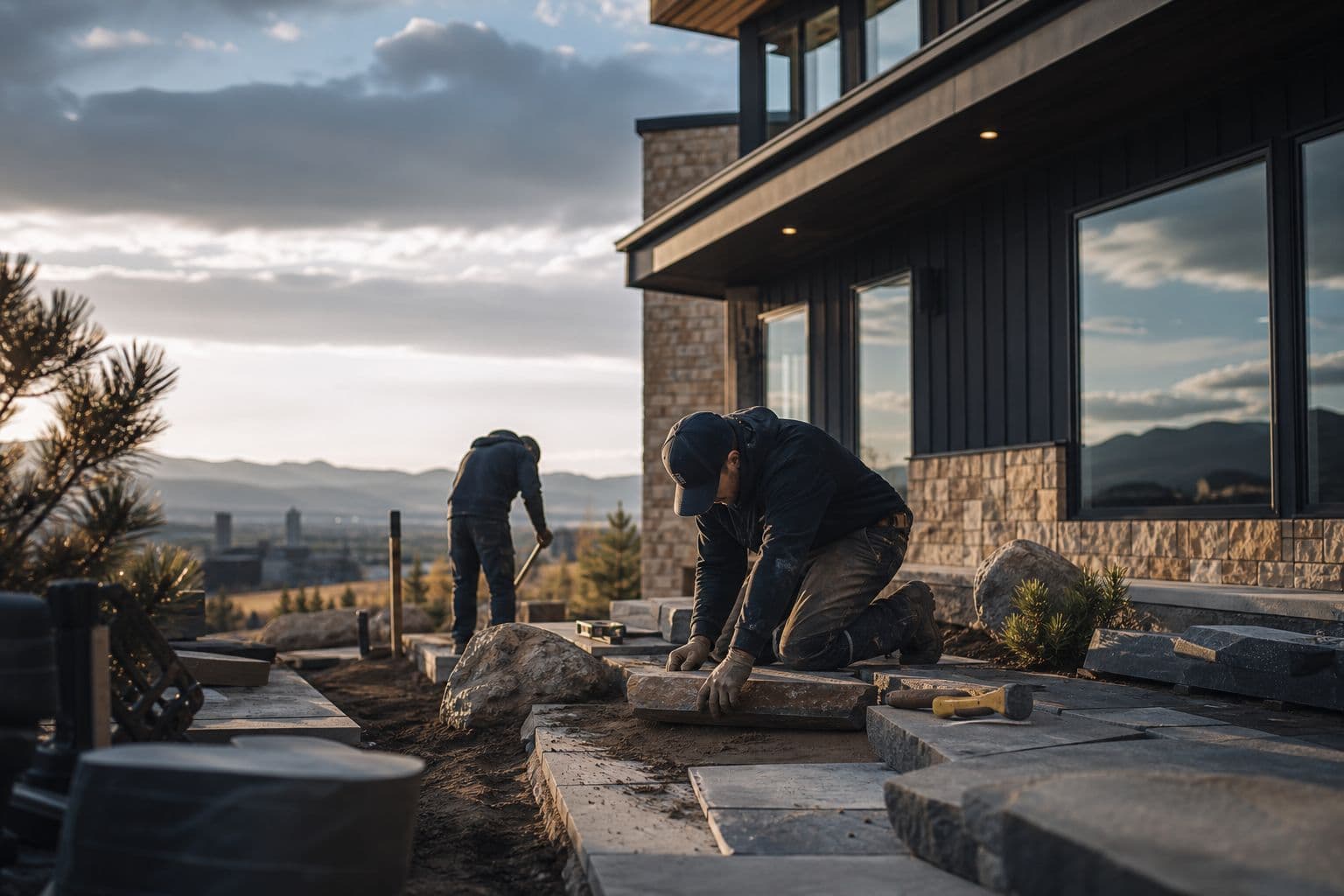
Landscaping Services in Castle Rock, Colorado
Autotelic provides professional landscaping services throughout Castle Rock and the surrounding Douglas County area. Full landscape design and installation including hardscape, softscape, irrigation, and landscape lighting. Whether you're in Castle Rock (Douglas County seat) or nearby communities, our team delivers quality workmanship backed by Colorado licensing and full insurance coverage.
The build sequence for a Landscaping project
Every project starts with a feasibility study; this trade is priced from the same assemblies.
Permit Thresholds
Castle Rock permit thresholds
- Code reference
- Exempt work follows the Town’s adopted amendments to the 2024 International Residential Code (IRC) and International Building Code (IBC), per Ordinance No. 2026-017 (effective around June 30, 2026).Ord. No. 2026-017
- Code reference
- One-story detached accessory non-habitable structures (tool sheds, playhouses, etc.) ≤ 120 sq ft, ≥ 10 ft from the nearest occupiable structure.
- Code reference
- Fences ≤ 6 ft high (swimming pool barriers of any height are *not* exempt).
- Code reference
- Shingle repair or replacement not exceeding one square (100 sq ft) of covering per building.
- Code reference
- The adopted codes (2024 IRC/IBC and related) govern when alterations trigger permitting.
- Code reference
- See Title 15 of the Castle Rock Municipal Code (and amendments in Ordinance 2026-017) for the full adopted code language on work exempt from permit (primarily amending IRC R105.2 and equivalent IBC sections).Ord. 2026-017
- Building use tax
- 5.2% applied to 50% of the project’s valuation (materials estimated at half the valuation).
- Code reference
- This comprises the Town’s 4.2% use tax rate + Douglas County’s 1% use tax rate.
Codes are amended regularly — verify current requirements with **The Town of Castle Rock Building Division (part of Development Services) issues residential building permits within the town limits.
Energy Code
Castle Rock energy code quick facts
- Code reference
- 2021 International Energy Conservation Code (IECC), with local amendments, as adopted by Ordinance No. 2026-017 (adopted June 2, 2026; effective June 30, 2026), along with the Colorado Model Electric-Ready and Solar-Ready Code.Ord. No. 2026-017
- Code reference
- This applies to Castle Rock (Douglas County, Climate Zone 5B).
- Code reference
- The adoption aligns with state requirements for jurisdictions updating other building codes by the June 30, 2026 deadline.
- Code reference
- Specific local numeric amendments to prescriptive requirements (e.g., R-values, U-factors, or air-sealing thresholds for remodels/additions) are not detailed in publicly available sources beyond references to the base 2021 IECC tables/sections (such as Table R402.1.2 for insulation/fenestration and
- Code reference
- The adopting ordinance incorporates the 2021 IECC by reference with amendments thereto but does not appear to alter the core prescriptive values in available excerpts.
Codes are amended regularly — verify current requirements with **The Town of Castle Rock Building Division (part of Development Services) issues residential building permits within the town limits.
text
What landscaping work covers in the Denver metro
Landscaping in the Denver metro commonly includes grading and drainage, sod or xeriscape planting, trees and shrubs suited to Front Range conditions, hardscape such as patios and walkways, fencing, and outdoor living elements. Commercial sites may also need parking-lot islands, screening, snow-storage planning, and maintenance access. A municipally licensed Denver general contractor coordinates the overall outdoor scope and the licensed specialty trades required when electrical, plumbing, or structural elements are part of the project. Cost is project-specific and depends on area, materials, access, and whether irrigation or lighting is included.
text
Front Range climate and material choices
Denver-area landscaping has to handle freeze-thaw cycles, intense sun, hail, and limited water. Plant palettes often favor drought-tolerant and native or adapted species. Hardscape materials should be selected for freeze resistance and drainage, especially where snow melt and ice are expected. A practical plan also accounts for HOA or municipal design rules, utility locate requirements before digging, and how roof runoff and yard drainage will move water away from structures.
text
Hardscape, irrigation, and outdoor living
Hardscape packages may include concrete or paver patios, walkways, retaining walls, steps, and outdoor kitchens or seating areas. Irrigation design should match planting zones and local watering rules. Low-voltage lighting and outdoor power, when included, are coordinated with the specialty trades that perform that work. Retaining walls, elevated decks, and structures with roofs or electrical service may trigger building permits. Scope should separate plant install from structural or utility work so inspections stay clear.
text
Permits and who coordinates the work
Simple planting may not need a building permit, but grading changes, retaining walls, fences over local height limits, electrical outdoor circuits, and gas lines for outdoor appliances often do. Cities and counties license general contractors. Colorado has no statewide general contractor license. Autotelic acts as a municipally licensed Denver general contractor and coordinates licensed specialty trades when the outdoor package includes regulated work. Permit responsibility should be stated up front.
FAQ
Common questions
What should a Denver landscaping plan include?
Existing grades and drainage, planting zones, hardscape footprints, irrigation intent, utility locations, and any retaining walls or outdoor structures. Photos and a rough budget band help, but final pricing stays project-specific.
Who handles landscaping permits and licensing?
A municipally licensed Denver general contractor coordinates the project and the licensed specialty trades required for regulated portions of the work. Local city or county departments issue applicable permits. Colorado has no statewide general contractor license.
Is xeriscape practical for Denver yards?
Often yes. Drought-tolerant and adapted plantings reduce water demand when paired with soil prep, mulch, and irrigation zoning. The right mix depends on sun exposure, slope, and how the yard will be used.
How is commercial landscaping different from residential work?
Commercial sites usually need clearer access for maintenance equipment, parking and pedestrian circulation, snow storage, and longer-term durability of plantings and hardscape. Phasing around open businesses is common.
When do outdoor living features need a building permit?
Elevated decks, covered structures, retaining walls above local thresholds, and outdoor electrical or gas work commonly need review. Exact triggers depend on the city or county and the structure details.
Service Area
Serving Castle Rock and Douglas County
We serve Castle Rock, CO and all surrounding Denver metro communities. Our team is based in Denver and operates throughout the Front Range, from Castle Rock to Longmont and everywhere in between. Contact us for a free estimate on your Castle Rock project.
How It Runs
01
Survey
02
Design
03
Build
04
Verify
DESIGN SERVICES
Discovery & Site Analysis
Needs + preference programming, site survey, as-built documentation, feasibility.
We walk, measure, and photograph your property — existing conditions, utilities, structure, and constraints. You get the as-built documentation and feasibility read that every later decision rests on.
Learn more →Concept Design & Space Planning
Schematic design, floor plan studies, layout options.
Your scope becomes schematic floor plans you can compare side by side — circulation, daylight, adjacencies, and what each option does to the budget. Layout decisions happen on paper, where changes are cheap.
Learn more →Architectural Design & 3D Renderings
Design development, materials + finishes, photorealistic visualization.
The chosen concept resolves into materials, finishes, fixtures, and lighting — with the automation layer drawn in. Photorealistic renderings let you walk the space and adjust before anything is priced.
Learn more →Construction Documents & Permitting
Full CD sets, structural + MEP engineering coordination, permit-ready drawings.
Approved designs become coordinated architectural, structural, and MEP sheets — the set your jurisdiction permits from and trades build from. We submit, track, and answer review comments.
Learn more →CONSTRUCTION
New Construction & Custom Homes
Ground-up homes and light commercial, dirt to keys.
Ground-up residential and light commercial builds — foundations through finishes, including modular and steel construction. One accountable builder from dirt to keys.
Learn more →Remodels & Additions
Kitchens, baths, basements, pop-tops, whole-home.
Kitchens, baths, basements, pop-tops, and whole-home renovations that respect the house you already have. We handle structure, permits, and the dust.
Learn more →Commercial Tenant Finish & Build-Outs
Shells to working spaces — retail, office, restaurant, school.
Raw shells become working spaces — showrooms, offices, restaurants, schools. Dealer-spec finishes, code compliance, and opening dates held.
Learn more →ADUs & Modular Construction
Backyard cottages, garage conversions, factory-built homes.
Backyard cottages, garage conversions, and factory-built homes — zoning, design, permits, and set. Denver’s ADU rules are a specialty, not a surprise.
Learn more →Outdoor Living & Patio Structures
Decks, pergolas, and dining patios built for Colorado weather.
Decks, pergolas, and dining patios engineered for Colorado sun, snow, and hail — structure, shade, and drainage done right the first time.
Learn more →TECHNOLOGY
Smart Home Automation
Lighting, shades, climate, audio, security — one interface.
Whole-home control of lighting, shades, climate, audio, and security from a single interface — Crestron, Lutron, Savant, and Control4 designed in, not bolted on.
Learn more →A/V Systems
Theaters, distributed audio, video walls, commercial sound.
Theaters, distributed audio, video walls, and commercial sound — designed, installed, and tuned by the same team for over 20 years.
Learn more →Control Systems
Custom programming — scenes and schedules that fit the space.
Every subsystem brought into one elegant interface — custom programming for homes and venues, with scenes and schedules that match how the space is actually used.
Learn more →Networking & Edge Compute
Enterprise Wi-Fi, structured cabling, racks, on-prem compute.
Enterprise-grade Wi-Fi, structured cabling, racks, and on-premise compute — the backbone that makes everything else reliable, including our own Barbot platform.
Learn more →Solar & Energy Storage
Solar arrays, Tesla Powerwall, EV charging — certified install.
Solar arrays, Tesla Powerwall, and EV charging designed and installed by a Tesla Energy Certified team — roof, electrical, and app in one scope.
Learn more →Explore