DESIGN · BUILD · AUTOMATE
COMMERCE CITY SERVICES
Stucco & EIFS in Commerce City
Site visit and written estimate, $149
Licensed stucco & eifs services for Commerce City and Adams County. Durable exterior finishes.
What Commerce City requires
Code reference: These rules are in Commerce City Revised Municipal Code Chapter 5 (Buildings and Building Regulations), Article I, particularly Sec. 5-5 (scope of the City of Commerce City Building Code and work exempt from code provisions) and the referenced Sec. 5-8 (work exempt from permit requirements). §5-5
See full local requirements ↓- Full Design Lifecycle
- Construction & Tenant Finish
- Smart Home · A/V · Edge Compute
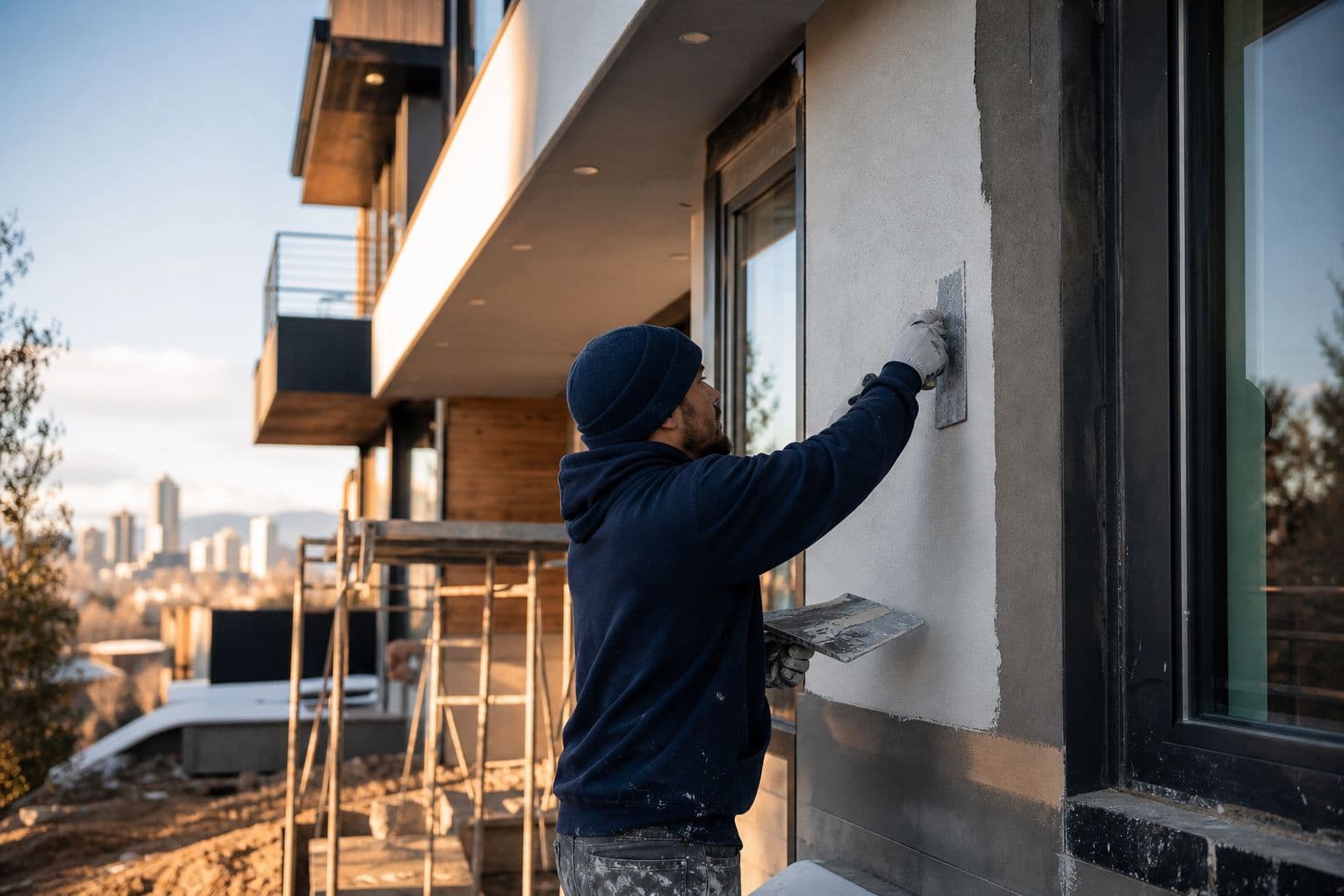
Durable exterior finishes
Book online
Pick your job and choose a time.
Pay when you book. We confirm within 24 hours or refund you in full.
Site visit and written estimate
We come out, look at the job and send you a written estimate.
Pay when you book · morning (8–12) or afternoon (12–4)
What's included
We come out, look at the job and send you a written estimate. The visit is credited to the job if you go ahead.
FREE PLANNING TOOLS
Both tools are free and take a couple of minutes — start in either one.
EVERY PROJECT STARTS WITH DESIGN
Local Service
Stucco & EIFS Services in Commerce City, Colorado
Autotelic provides professional stucco & eifs services throughout Commerce City and the surrounding Adams County area. Traditional stucco and EIFS (exterior insulation finish system) installation and reclad for commercial and residential exteriors. Whether you're in Commerce City (northeast Denver metro) or nearby communities, our team delivers quality workmanship, licensed and insured.
The build sequence for a Stucco & EIFS project
Every project starts with a feasibility study; this trade is priced from the same assemblies.
Permit Thresholds
Commerce City permit thresholds
- Code reference
- Residential roof sheathing replacements of 256 square feet and under (unless required to be fire-retardant).
- Code reference
- Gutters, kitchen cabinets, on-grade patios, driveways, and certain other minor items (e.g., fences meeting height limits, playground equipment, retaining walls 4 feet and under without surcharge).
- Code reference
- These rules are in Commerce City Revised Municipal Code Chapter 5 (Buildings and Building Regulations), Article I, particularly Sec. 5-5 (scope of the City of Commerce City Building Code and work exempt from code provisions) and the referenced Sec. 5-8 (work exempt from permit requirements).§5-5
- Code reference
- The city adopts the 2021 IBC/IRC and related codes with local amendments.
- Code reference
- Use tax is collected at 4.5% applied to the dollar cost and/or value of all building and construction materials intended to be used and/or consumed as part of the project (not collapsed into a single rate; confirmed for small projects valued at $500 or less, where the permit fee is $23.50 and th
Codes are amended regularly — verify current requirements with **The Building Safety Division (part of the City of Commerce City’s Community Development Department) issues residential building permits.
Energy Code
Commerce City energy code quick facts
- Code reference
- 2021 IECC (as the City of Commerce City Energy Conservation Code), with local amendments.
- Code reference
- Commerce City adopts the 2021 edition of the International Energy Conservation Code (IECC) as its Energy Conservation Code (both commercial and residential provisions apply, per the city’s Building Code).
- Code reference
- This is incorporated by reference in the Commerce City Revised Municipal Code (C3BC), primarily via Sec. 5-2 (Incorporation by reference), which lists the 2021 IECC among the adopted codes.§5-2
- Code reference
- It is further detailed and locally amended on the city’s official page for the 2021 IECC.
- Code reference
- The city’s amendments (detailed on the official 2021 IECC adoption page) are primarily administrative/procedural and do not alter the core prescriptive tables or performance requirements of the 2021 IECC itself.
- Code reference
- Amending C101.1 (Title) to reference the City of Commerce City Commercial Energy Conservation Code.
- Code reference
- Requiring digital submission of construction documents with specific energy-related details (e.g., insulation R-values, fenestration U-factors/SHGC, air barrier details).
- Code reference
- Deleting/replacing the fees section (C104) to tie into the city’s municipal code Article VI, Chapter 5.
Codes are amended regularly — verify current requirements with **The Building Safety Division (part of the City of Commerce City’s Community Development Department) issues residential building permits.
text
What this covers
Cement stucco or exterior insulation finish over a drained assembly. Lath, weather barrier, and kickout flashing decide whether the wall stays dry.
FAQ
Common questions
How much does Site visit and written estimate cost in Commerce City?
$149.
How do I book?
Press Book next to the job, pick a date and a morning (8–12) or afternoon (12–4) window, and pay in full. We confirm within 24 hours or refund you in full.
Who handles the stucco & eifs permits and licensing?
A municipally licensed Denver general contractor coordinates licensed specialty trades. Colorado has no statewide general-contractor license; cities and counties license general contractors. DORA licenses electrical and plumbing, not general contractors.
What is typically in scope for stucco & eifs in Denver?
Cement stucco or exterior insulation finish over a drained assembly.
Service Area
Serving Commerce City and Adams County
We serve Commerce City, CO and all surrounding Denver metro communities. Our team is based in Denver and operates throughout the Front Range, from Castle Rock to Longmont and everywhere in between. Contact us for a free estimate on your Commerce City project.
How It Runs
01
Survey
02
Design
03
Build
04
Verify
DESIGN SERVICES
Discovery & Site Analysis
Needs + preference programming, site survey, as-built documentation, feasibility.
We walk, measure, and photograph your property — existing conditions, utilities, structure, and constraints. You get the as-built documentation and feasibility read that every later decision rests on.
Learn more →Concept Design & Space Planning
Schematic design, floor plan studies, layout options.
Your scope becomes schematic floor plans you can compare side by side — circulation, daylight, adjacencies, and what each option does to the budget. Layout decisions happen on paper, where changes are cheap.
Learn more →Architectural Design & 3D Renderings
Design development, materials + finishes, photorealistic visualization.
The chosen concept resolves into materials, finishes, fixtures, and lighting — with the automation layer drawn in. Photorealistic renderings let you walk the space and adjust before anything is priced.
Learn more →Construction Documents & Permitting
Full CD sets, structural + MEP engineering coordination, permit-ready drawings.
Approved designs become coordinated architectural, structural, and MEP sheets — the set your jurisdiction permits from and trades build from. We submit, track, and answer review comments.
Learn more →CONSTRUCTION
New Construction & Custom Homes
Ground-up homes and light commercial, dirt to keys.
Ground-up residential and light commercial builds — foundations through finishes, including modular and steel construction. One accountable builder from dirt to keys.
Learn more →Remodels & Additions
Kitchens, baths, basements, pop-tops, whole-home.
Kitchens, baths, basements, pop-tops, and whole-home renovations that respect the house you already have. We handle structure, permits, and the dust.
Learn more →Commercial Tenant Finish & Build-Outs
Shells to working spaces — retail, office, restaurant, school.
Raw shells become working spaces — showrooms, offices, restaurants, schools. Dealer-spec finishes, code compliance, and opening dates held.
Learn more →ADUs & Modular Construction
Backyard cottages, garage conversions, factory-built homes.
Backyard cottages, garage conversions, and factory-built homes — zoning, design, permits, and set. Denver’s ADU rules are a specialty, not a surprise.
Learn more →Outdoor Living & Patio Structures
Decks, pergolas, and dining patios built for Colorado weather.
Decks, pergolas, and dining patios engineered for Colorado sun, snow, and hail — structure, shade, and drainage done right the first time.
Learn more →TECHNOLOGY
Smart Home Automation
Lighting, shades, climate, audio, security — one interface.
Whole-home control of lighting, shades, climate, audio, and security from a single interface — Crestron, Lutron, Savant, and Control4 designed in, not bolted on.
Learn more →A/V Systems
Theaters, distributed audio, video walls, commercial sound.
Theaters, distributed audio, video walls, and commercial sound — designed, installed, and tuned by the same team for over 20 years.
Learn more →Control Systems
Custom programming — scenes and schedules that fit the space.
Every subsystem brought into one elegant interface — custom programming for homes and venues, with scenes and schedules that match how the space is actually used.
Learn more →Networking & Edge Compute
Enterprise Wi-Fi, structured cabling, racks, on-prem compute.
Enterprise-grade Wi-Fi, structured cabling, racks, and on-premise compute — the backbone that makes everything else reliable, including our own Barbot platform.
Learn more →Solar & Energy Storage
Solar arrays, Tesla Powerwall, EV charging — certified install.
Solar arrays, Tesla Powerwall, and EV charging designed and installed by a Tesla Energy Certified team — roof, electrical, and app in one scope.
Learn more →Explore