DESIGN · BUILD · AUTOMATE
WESTMINSTER SERVICES
Electrical in Westminster
Light Fixture Replacement — Standard Height, $175
See all 33 jobsWe coordinate the electrician. Electrical jobs for Denver-metro homes, booked online.
What Westminster requires
Code reference: The primary source is the City of Westminster Building Division’s *Residential Building Permit Requirements* document (updated August 22, 2024), available on the official city website. per City of Westminster — Building Division (Community Services Department)
See full local requirements ↓- Full Design Lifecycle
- Construction & Tenant Finish
- Smart Home · A/V · Edge Compute
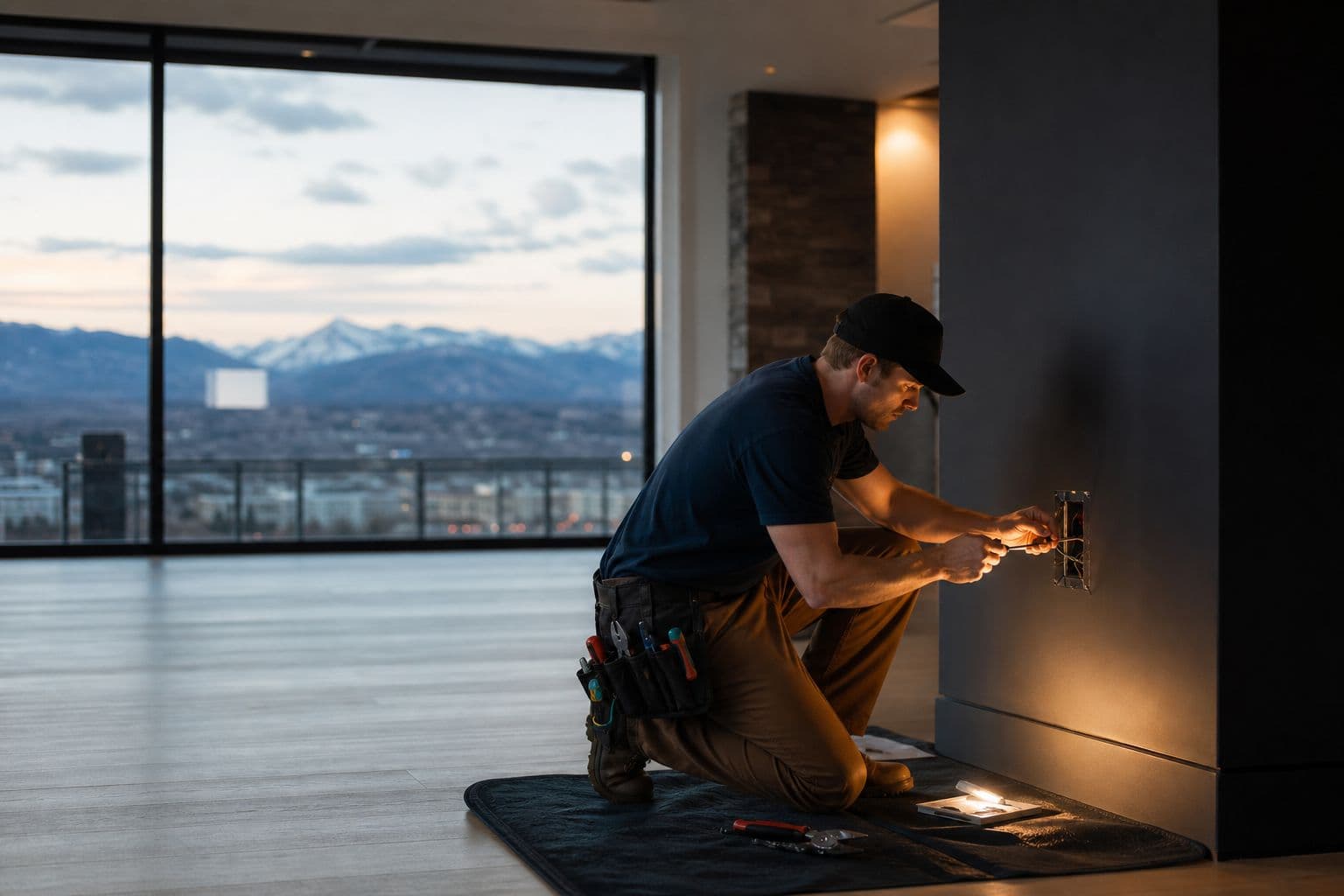
Electrical jobs for Denver-metro homes, booked online
Jobs you can book online
Pick your job and choose a time.
Pay when you book. We confirm within 24 hours or refund you in full.
Emergency visits
Emergency Electrical — Outage or Hazard
$229 visit fee — credited toward the work
Confirmed within 2 hours or fully refunded.
Priority response for partial or full power loss, burning smells, buzzing panels, or sparking devices — we make it safe first, then quote the fix.
Pay when you book
What's included
Priority response for partial or full power loss, burning smells, buzzing panels, or sparking devices — we make it safe first, then quote the fix. The $229 emergency fee applies toward the repair.
Fixed-price jobs
Light Fixture Replacement — Standard Height
Remove existing surface-mount or semi-flush light fixture and install customer-supplied replacement on existing ceiling or wall box, ceilings up to 10 ft.
Pay when you book · morning (8–12) or afternoon (12–4)
What's included
Remove existing surface-mount or semi-flush light fixture and install customer-supplied replacement on existing ceiling or wall box, ceilings up to 10 ft. Includes disconnect, mounting, wiring to existing conductors, and function test. Assumes existing box is properly secured and wiring is in serviceable condition. Excludes new circuits, box replacement, fixtures over 25 lbs, and ceilings over 10 ft (see high-ceiling variant).
Ceiling Fan Install (Existing Wiring)
Install a customer-supplied ceiling fan at an existing fan-rated box with existing switched wiring, up to 12-ft ceilings.
Pay when you book · morning (8–12) or afternoon (12–4)
What's included
Install a customer-supplied ceiling fan at an existing fan-rated box with existing switched wiring, up to 12-ft ceilings. New circuits, boxes, or bracing are quoted separately.
Light Fixture Replacement — High Ceiling (10-16 ft)
Replace existing light fixture on ceilings 10-16 ft using extension ladder or podium ladder, customer-supplied fixture.
Pay when you book · morning (8–12) or afternoon (12–4)
What's included
Replace existing light fixture on ceilings 10-16 ft using extension ladder or podium ladder, customer-supplied fixture. Includes disconnect, mounting, wiring to existing conductors, and function test. Assumes existing box is secure, clear ladder access to the fixture location, and fixture under 35 lbs. Excludes ceilings over 16 ft, stairwell locations requiring scaffold (see chandelier staircase variant), box replacement, and new circuits.
Chandelier Hang — Standard Ceiling
Assemble and hang customer-supplied chandelier up to 50 lbs on existing fan-rated or properly braced ceiling box, ceilings up to 12 ft.
Pay when you book · morning (8–12) or afternoon (12–4)
What's included
Assemble and hang customer-supplied chandelier up to 50 lbs on existing fan-rated or properly braced ceiling box, ceilings up to 12 ft. Includes chain/downrod adjustment, wiring, canopy trim, and function test. Assumes existing box is rated for fixture weight; partial pre-assembly by homeowner welcome but not required. Excludes staircase/two-story installs, chandeliers over 50 lbs, box bracing upgrades, and lift rentals.
Electrical Panel & Load Evaluation (EV / Solar Readiness)
Load calculation and panel inspection to determine capacity for EV charging, battery storage, or solar interconnection, with a written report of upgrade options and firm pricing.
Pay when you book · morning (8–12) or afternoon (12–4)
What's included
Load calculation and panel inspection to determine capacity for EV charging, battery storage, or solar interconnection, with a written report of upgrade options and firm pricing. Panel upgrades and electrical repairs are not included.
Dryer Outlet Conversion — 3-Prong to 4-Prong
Replace existing 3-prong (NEMA 10-30) dryer receptacle with a 4-prong (NEMA 14-30) receptacle where the existing cable contains a separate equipment ground or is 4-conductor (receptacle included), plus matching 4-prong…
Pay when you book · morning (8–12) or afternoon (12–4)
What's included
Replace existing 3-prong (NEMA 10-30) dryer receptacle with a 4-prong (NEMA 14-30) receptacle where the existing cable contains a separate equipment ground or is 4-conductor (receptacle included), plus matching 4-prong cord swap on the dryer if needed. Includes verification of conductor configuration and test. IMPORTANT ASSUMPTION: existing branch cable must have 4 conductors or an acceptable grounding path — verified on site; if the cable is 3-wire without ground, the conversion is not code-legal and the visit converts to a diagnostic with a quote for a new circuit run (excluded from this task).
Under-Cabinet Lighting — Plug-In System
Mount customer-supplied plug-in LED under-cabinet lighting (up to 5 light bars or 20 linear ft of tape) under kitchen cabinets, with concealed wire routing along cabinet undersides and connection to an existing counter…
Pay when you book · morning (8–12) or afternoon (12–4)
What's included
Mount customer-supplied plug-in LED under-cabinet lighting (up to 5 light bars or 20 linear ft of tape) under kitchen cabinets, with concealed wire routing along cabinet undersides and connection to an existing counter receptacle. Includes clean cable management and dimmer/controller setup if included with the kit. Assumes an existing receptacle is within cord reach. Excludes cutting into walls or cabinets, hardwiring (see hardwired variant), and new receptacles.
Doorbell Transformer Upgrade
Replace existing doorbell transformer with a 16V/30VA (or 24V as required) upgraded transformer to support video doorbells (transformer included).
Pay when you book · morning (8–12) or afternoon (12–4)
What's included
Replace existing doorbell transformer with a 16V/30VA (or 24V as required) upgraded transformer to support video doorbells (transformer included). Includes locating the existing transformer, swap at its existing junction point, chime bypass/power kit install if supplied with the doorbell, and voltage verification at the door. Assumes the existing transformer is accessible (furnace room, basement, closet, or attic within reach) and low-voltage wiring to the door is intact. Excludes running new low-voltage wire and troubleshooting broken buried bell wire — visit-quoted.
Show 14 more jobs
3-Way Dimmer Conversion — Switch Pair
Convert one existing 3-way switch pair to dimming control: install a 3-way-capable dimmer at one location and matching companion/3-way switch at the other, using existing traveler wiring (standard hardware included;…
Pay when you book · morning (8–12) or afternoon (12–4)
What's included
Convert one existing 3-way switch pair to dimming control: install a 3-way-capable dimmer at one location and matching companion/3-way switch at the other, using existing traveler wiring (standard hardware included; smart kits customer-supplied). Includes wiring identification, both device installs, plates, and full-circuit test from both locations. Assumes existing 3-way travelers are intact. Excludes 4-way (three-location) circuits and repairing miswired legacy circuits — quoted on site if found.
Ceiling Fan with Light Kit — Existing Fan-Rated Box
Remove existing fan or fixture and install customer-supplied ceiling fan with attached light kit on an existing fan-rated box, ceilings up to 10 ft.
Pay when you book · morning (8–12) or afternoon (12–4)
What's included
Remove existing fan or fixture and install customer-supplied ceiling fan with attached light kit on an existing fan-rated box, ceilings up to 10 ft. Includes full assembly, light kit wiring, balancing, and testing fan and light functions on existing switching. Assumes fan-rated box and existing switch wiring; single-switch homes get fan/light on pull chains unless a remote kit is added. Excludes new switch legs, brace-box upgrades, and high ceilings.
Chandelier Hang — Staircase / Two-Story Foyer
Assemble and hang customer-supplied chandelier in a staircase or two-story foyer up to 20 ft using ladder-jack/plank or podium system (equipment included).
Pay when you book · morning (8–12) or afternoon (12–4)
What's included
Assemble and hang customer-supplied chandelier in a staircase or two-story foyer up to 20 ft using ladder-jack/plank or podium system (equipment included). Two-person crew. Includes assembly, chain adjustment for proper hang height, wiring to existing box, and function test. Assumes existing box is fan/fixture-rated for the weight and stair or floor access permits safe staging. Excludes fixtures over 75 lbs, ceilings over 20 ft, powered lift rental, and structural box installation — those are visit-quoted.
Closet Light Code-Compliance Swap
Replace non-compliant closet fixture (bare-bulb keyless, pull-chain incandescent) with a code-compliant enclosed LED fixture at the existing box location, maintaining required clearances from shelving per NEC 410.16…
Pay when you book · morning (8–12) or afternoon (12–4)
What's included
Replace non-compliant closet fixture (bare-bulb keyless, pull-chain incandescent) with a code-compliant enclosed LED fixture at the existing box location, maintaining required clearances from shelving per NEC 410.16 (standard LED flush fixture included, or customer-supplied). Includes wiring, mounting, and pull-chain-to-existing-switch retention as found. Assumes an existing box with power; if clearance requires relocating the box, that portion is visit-quoted. Excludes new switch legs and shelf modifications.
Exterior Outlet Weatherproof In-Use Cover Upgrade
Upgrade one existing exterior receptacle with a code-compliant weatherproof in-use (bubble) cover and gasket, including a weather-resistant GFCI receptacle swap at that location if the existing device is not WR-rated…
Pay when you book · morning (8–12) or afternoon (12–4)
What's included
Upgrade one existing exterior receptacle with a code-compliant weatherproof in-use (bubble) cover and gasket, including a weather-resistant GFCI receptacle swap at that location if the existing device is not WR-rated (materials included). Includes sealing to siding/stucco surface and trip test. Assumes existing exterior box is intact and accessible at ground/ladder height up to 12 ft. Excludes new exterior outlet locations and box replacement.
Floodlight / Security Light Swap — Existing Box
Replace existing exterior floodlight or motion security light with a customer-supplied unit (including camera floodlights) on the existing wall or eave box up to 16 ft ladder height.
Pay when you book · morning (8–12) or afternoon (12–4)
What's included
Replace existing exterior floodlight or motion security light with a customer-supplied unit (including camera floodlights) on the existing wall or eave box up to 16 ft ladder height. Includes weatherproof mounting, wiring, motion sensitivity/aim adjustment, and app pairing walkthrough for smart units on your Wi-Fi. Assumes existing switched or always-hot power at the box matches the new unit's requirements. Excludes new box locations, ceilings/eaves over 16 ft, and Wi-Fi network troubleshooting.
Garage LED Shop Lighting (Up to 4 Fixtures)
Install up to four customer-supplied linkable LED shop lights on existing garage circuits with switching check.
Pay when you book · morning (8–12) or afternoon (12–4)
What's included
Install up to four customer-supplied linkable LED shop lights on existing garage circuits with switching check. New circuits are quoted on site.
Light Switch Relocation — Same Stud Bay
Relocate one existing light switch vertically or a few inches horizontally WITHIN the same stud bay (e.g., raise/lower for accessibility or furniture clearance): cut in new old-work box, extend existing conductors with…
Pay when you book · morning (8–12) or afternoon (12–4)
What's included
Relocate one existing light switch vertically or a few inches horizontally WITHIN the same stud bay (e.g., raise/lower for accessibility or furniture clearance): cut in new old-work box, extend existing conductors with code-compliant splices, install device and plate, and blank-cover the old box. Assumes drywall interior wall, same stud bay only, and existing cable has enough slack or accepts an accessible junction. Includes rough drywall cut only — finish patch, texture, and paint are EXCLUDED. Crossing studs, fire-blocked bays, insulated exterior walls, and plaster walls are excluded and visit-quoted.
Line-Voltage Thermostat Swap (baseboard/wall heater)
Replace existing 120V/240V line-voltage thermostat controlling electric baseboard or wall heater with a customer-supplied or standard programmable double-pole replacement at the same wall location.
Pay when you book · morning (8–12) or afternoon (12–4)
What's included
Replace existing 120V/240V line-voltage thermostat controlling electric baseboard or wall heater with a customer-supplied or standard programmable double-pole replacement at the same wall location. Includes load verification, wiring, and heat-cycle test. Assumes single heating zone at one existing thermostat location with serviceable wiring, and replacement is rated for the connected heater load. Excludes low-voltage HVAC thermostats, relocations, and multi-zone rewiring.
Motion Sensor Switch Installation (existing switch location)
Replace an existing wall switch with an occupancy/vacancy motion sensor switch (standard unit included, or customer-supplied) for garages, laundry, closets, or baths.
Pay when you book · morning (8–12) or afternoon (12–4)
What's included
Replace an existing wall switch with an occupancy/vacancy motion sensor switch (standard unit included, or customer-supplied) for garages, laundry, closets, or baths. Includes wiring, sensitivity and timeout configuration, and test. Assumes single-pole location; neutral required for most units — confirmed at booking or a no-neutral-compatible model is used. Excludes 3-way sensor pairs and new switch locations.
Timer Switch Installation (existing switch location)
Replace an existing switch with a programmable or countdown timer switch (standard unit included, or customer-supplied) for bath fans, exterior lights, or holiday circuits.
Pay when you book · morning (8–12) or afternoon (12–4)
What's included
Replace an existing switch with a programmable or countdown timer switch (standard unit included, or customer-supplied) for bath fans, exterior lights, or holiday circuits. Includes wiring, programming to your schedule, and walkthrough. Assumes a neutral conductor is present in the box for digital timers — if no neutral, a mechanical timer is installed instead or the task converts to a visit-quote. Excludes new switch locations.
Track Lighting Swap — Existing Track Location
Remove existing track lighting and install customer-supplied replacement track system (up to 8 linear ft of track and 6 heads) fed from the existing ceiling box, ceilings up to 10 ft.
Pay when you book · morning (8–12) or afternoon (12–4)
What's included
Remove existing track lighting and install customer-supplied replacement track system (up to 8 linear ft of track and 6 heads) fed from the existing ceiling box, ceilings up to 10 ft. Includes live-end connector wiring, track mounting, head placement, aiming, and dimmer compatibility check. Assumes existing switched box powers the track from one feed point. Excludes multi-feed track layouts, monorail systems requiring remote transformers in new locations, and ceilings over 10 ft.
Under-Cabinet Lighting — Hardwired to Existing Switch
Install customer-supplied hardwired LED under-cabinet fixtures (up to 5 fixtures) connected to an EXISTING switched under-cabinet circuit — i.e., replacing old hardwired under-cabinet lights or using an existing…
Pay when you book · morning (8–12) or afternoon (12–4)
What's included
Install customer-supplied hardwired LED under-cabinet fixtures (up to 5 fixtures) connected to an EXISTING switched under-cabinet circuit — i.e., replacing old hardwired under-cabinet lights or using an existing switched junction point at the cabinet run. Includes fixture mounting, interconnect wiring between units, and testing on the existing switch. Assumes switched power already exists at the cabinet run. Excludes fishing new switch legs through walls, new circuits, and backsplash/drywall repair — those are visit-quoted.
Whole-House Outlet & Switch Plate Refresh
Replace up to 40 outlet and switch cover plates throughout the home with customer-supplied plates (or standard white included), straightening crooked devices, replacing stripped plate screws, and flagging any device…
Pay when you book · morning (8–12) or afternoon (12–4)
What's included
Replace up to 40 outlet and switch cover plates throughout the home with customer-supplied plates (or standard white included), straightening crooked devices, replacing stripped plate screws, and flagging any device found damaged, hot, or loose in its box for a follow-up quote. Assumes plates only — devices themselves are not replaced under this task (see per-device replacement). Excludes homes over 40 plates (quoted as a second unit), oversized/goof-ring situations requiring drywall work, and painting.
Priced per item
Dimmer Switch Installation (per device, existing switch location)
$65 each · $55 each for 7+ · $129 minimum visit
Replace existing single-pole switch with customer-supplied or standard LED-compatible dimmer at an existing switch location.
Pay when you book · morning (8–12) or afternoon (12–4)
What's included
Replace existing single-pole switch with customer-supplied or standard LED-compatible dimmer at an existing switch location. Add about 20 minutes per additional device. Includes removal, wiring, plate, and load compatibility check. Assumes existing box wiring is serviceable; smart dimmers requiring a neutral are covered only if a neutral is present in the box (see smart dimmer task). Excludes 3-way conversions (see pair task), new switch locations, and troubleshooting pre-existing circuit faults.
Fluorescent-to-LED Tube Retrofit (per fixture)
$75 each · $65 each for 9+ · $129 minimum visit
Retrofit existing fluorescent fixture to ballast-bypass (Type B) LED tubes: remove ballast, rewire sockets for direct-wire LED, install LED tubes and relabel the fixture (tubes and non-shunted sockets included for…
Pay when you book · morning (8–12) or afternoon (12–4)
What's included
Retrofit existing fluorescent fixture to ballast-bypass (Type B) LED tubes: remove ballast, rewire sockets for direct-wire LED, install LED tubes and relabel the fixture (tubes and non-shunted sockets included for standard 2- and 4-lamp, 4-ft fixtures). About 30 minutes each additional fixture. Assumes fixtures at or below 12 ft with serviceable housings. Excludes full fixture replacement, high-bay fixtures over 12 ft, and emergency-ballast fixtures.
GFCI Outlet Installation (per device, existing outlet location)
$85 each · $75 each for 7+ · $129 minimum visit
Replace existing standard receptacle with a GFCI receptacle (device included) at kitchen, bath, garage, laundry, or exterior locations.
Pay when you book · morning (8–12) or afternoon (12–4)
What's included
Replace existing standard receptacle with a GFCI receptacle (device included) at kitchen, bath, garage, laundry, or exterior locations. About 25 minutes each additional device. Includes line/load identification, downstream protection labeling, and trip test. Assumes existing box depth accepts a GFCI body and wiring is serviceable; shallow-box replacements and dead-circuit troubleshooting are excluded and quoted on site.
Hardwired Smoke/CO Detector Swap (per unit)
$55 each · $45 each for 9+ · $129 minimum visit
Replace existing hardwired smoke or smoke/CO detectors with customer-supplied or standard interconnected replacements (10-year sealed units recommended) at existing ceiling/wall locations up to 10 ft.
Pay when you book · morning (8–12) or afternoon (12–4)
What's included
Replace existing hardwired smoke or smoke/CO detectors with customer-supplied or standard interconnected replacements (10-year sealed units recommended) at existing ceiling/wall locations up to 10 ft. About 15 minutes each additional unit. Includes harness adapter wiring, mounting, and whole-house interconnect test. Assumes existing hardwired interconnect wiring is functional. Excludes new detector locations, battery-only installs, and troubleshooting dead interconnect circuits — visit-quoted.
Pendant Light Installation (per pendant)
$95 each · $85 each for 6+ · $129 minimum visit
Install customer-supplied pendant lights on existing ceiling boxes (e.g., over an island where pendants or recessed conversion boxes already exist).
Pay when you book · morning (8–12) or afternoon (12–4)
What's included
Install customer-supplied pendant lights on existing ceiling boxes (e.g., over an island where pendants or recessed conversion boxes already exist). Add roughly 30 minutes per additional pendant. Includes cord/rod length adjustment, wiring, and test. Assumes one existing switched box per pendant, ceilings up to 10 ft. Excludes new box locations, recessed-to-pendant converter kits not supplied, and new circuits.
Recessed Lighting Install (Per Fixture, Existing Circuit)
$225 each · $195 each for 4–7 · $175 each for 8+ · $129 minimum visit
Cut in and wire canless LED recessed fixtures on an existing switched circuit with accessible ceiling framing, priced per fixture.
Pay when you book · morning (8–12) or afternoon (12–4)
What's included
Cut in and wire canless LED recessed fixtures on an existing switched circuit with accessible ceiling framing, priced per fixture. New circuits or insulated vaulted ceilings are quoted on site.
Smoke/CO Detector Install (Per Unit)
$95 each · $75 each for 3–5 · $65 each for 6+ · $129 minimum visit
Install customer-supplied or contractor-supplied (at cost) smoke and CO detectors, battery or existing hardwired base, priced per unit.
Pay when you book · morning (8–12) or afternoon (12–4)
What's included
Install customer-supplied or contractor-supplied (at cost) smoke and CO detectors, battery or existing hardwired base, priced per unit. Helps meet Colorado sale and rental compliance requirements.
Switch or Outlet Replacement (per device, like-for-like)
$50 each · $40 each for 11+ · $129 minimum visit
Like-for-like replacement of worn, discolored, or loose standard switches or receptacles at existing locations (standard 15A/20A devices and plates included, or customer-supplied decor devices).
Pay when you book · morning (8–12) or afternoon (12–4)
What's included
Like-for-like replacement of worn, discolored, or loose standard switches or receptacles at existing locations (standard 15A/20A devices and plates included, or customer-supplied decor devices). Assumes existing wiring and boxes are serviceable copper; aluminum-branch-circuit remediation, backstab burn repairs, and device relocations are excluded and visit-quoted if discovered.
USB Combo Outlet Installation (per device, existing outlet location)
$75 each · $65 each for 7+ · $129 minimum visit
Replace existing receptacle with a USB-A/USB-C combo charging receptacle (device included) at an existing outlet location.
Pay when you book · morning (8–12) or afternoon (12–4)
What's included
Replace existing receptacle with a USB-A/USB-C combo charging receptacle (device included) at an existing outlet location. Includes wiring, plate, and charge test. Assumes existing box depth accepts the deeper USB device body — confirmed on site; shallow boxes convert that location to a standard swap or visit-quote. Excludes new outlet locations.
Visit first, then quoted
Electrical Service Visit
$129 visit fee — credited toward the work
Licensed electrician troubleshoots circuits, panels, dead outlets, or flickering lights and quotes the fix before starting.
Pay when you book · morning (8–12) or afternoon (12–4)
What's included
Licensed electrician troubleshoots circuits, panels, dead outlets, or flickering lights and quotes the fix before starting. The $129 trip fee applies toward approved work.
FREE PLANNING TOOLS
Both tools are free and take a couple of minutes — start in either one.
EVERY PROJECT STARTS WITH DESIGN
Local Service
Electrical jobs in Westminster, Colorado
Electrical jobs in Westminster and the surrounding Adams/Jefferson County are booked online. We coordinate the electrician.
The build sequence for a Electrical project
Every project starts with a feasibility study; this trade is priced from the same assemblies.
Permits & Licensing
Permits in Westminster
Westminster building permits are issued by the Building Division within Community Services, and the city requires general contractors and mechanical, plumbing, and electrical subcontractors to be registered with the city before permit release. The permitting process is fully paperless, running through Westminster's eTRAKiT portal. Authority: City of Westminster — Building Division (Community Services Department).
Permit Thresholds
Westminster permit thresholds
- Code reference
- The primary source is the City of Westminster Building Division’s *Residential Building Permit Requirements* document (updated August 22, 2024), available on the official city website.
- Code reference
- Many exterior items common in remodels/additions (decks >30" above grade, room additions, attached/detached garages, retaining walls >3 ft or with surcharge, etc.) also require permits.
- Code reference
- Decks ≤30 inches above ground (with caveats).
- Code reference
- Stand-alone storage sheds ≤120 sq ft with no electrical/plumbing/mechanical.
- Code reference
- Minor roofing repair (≤100 sq ft).
- Code reference
- Minor siding repair (<100 sq ft).
- Code reference
- Retaining walls ≤36 inches in height (no surcharge).
Codes are amended regularly — verify current requirements with City of Westminster — Building Division (Community Services Department).
Energy Code
Westminster energy code quick facts
- Code reference
- Westminster, Colorado, has adopted the 2021 International Energy Conservation Code (IECC) together with the Colorado Model Electric Ready and Solar Ready Codes (as required by state law HB22-1362 for jurisdictions updating building codes).
- Code reference
- This applies to new construction, major renovations, remodels, and additions (with the building thermal envelope and other provisions triggered as applicable under the IECC).
- Code reference
- Westminster is in Climate Zone 5B.
- Code reference
- No unique local amendments decreasing stringency or deviating from the 2021 IECC prescriptive tables (plus the state model electric/solar-ready provisions) are indicated in available adoption materials.
- Code reference
- Key prescriptive requirements for remodels/additions (drawn from the adopted 2021 IECC Residential provisions, Table R402.1.2 / R402.1.3 and related sections; these apply where the scope triggers energy code compliance for the affected envelope components):
- Ceiling/attic insulation
- Minimum R-60 (or equivalent U-factor ≤ 0.026).
- Code reference
- (2021 IECC Table R402.1.2 / R402.1.3, Climate Zone 5.)
- Wood-frame wall insulation
- Minimum R-30 (or 20 + 5 ci, 13 + 10 ci, or 0 + 20 ci options) or equivalent U-factor ≤ 0.045.
Codes are amended regularly — verify current requirements with City of Westminster — Building Division (Community Services Department).
text
What electrical work covers in the Denver metro
Electrical projects in the Denver metro include troubleshooting failed devices, adding circuits, lighting upgrades, panel and service changes, EV charger circuits, generator transfer equipment, and remodel rough-in for kitchens, baths, and additions. Commercial tenant work often adds lighting packages and coordination with other building systems. A municipally licensed Denver general contractor coordinates the overall project and the licensed specialty trades required for regulated electrical work. Cost is project-specific and depends on service size, panel condition, circuit count, access, and inspection requirements.
text
Panels, capacity, and remodel sequencing
Many older Denver-metro homes need a capacity check before adding kitchen, HVAC, or EV loads. Panel space, grounding and bonding condition, and utility service size all affect whether a simple circuit add is enough or a service/panel upgrade is required. Remodel electrical usually roughs in before insulation and drywall, then finishes after paint. Final inspection should be planned into the close-out schedule.
text
What buyers should prepare
Useful details include symptoms or goals (tripping breakers, remodel plans, EV charger, generator), panel photos if available, known aluminum wiring or prior partial rewires, and the city or county of the property. For commercial spaces, note suite boundaries and any building-required coordination.
Installed cost
Electrical: typical 800 sq ft basement, installed
- Essential
- $5,500 – $6,500
- Premium
- $6,500 – $8,000
- Luxury
- $8,000 – $9,500
Prices as of September 2026 · Westminster projects are priced on the same Denver-metro estimate.
See materials and what's included →FAQ
Common questions
How much does Light Fixture Replacement — Standard Height cost in Westminster?
$175.
How do I book?
Press Book next to the job, pick a date and a morning (8–12) or afternoon (12–4) window, and pay in full. We confirm within 24 hours or refund you in full.
Can my panel support an EV charger or kitchen remodel?
It depends on service size, available breaker spaces, and existing loads. A site assessment should check capacity before ordering equipment.
How does electrical fit into a larger remodel?
Rough-in happens before walls close; device trim and finals happen after finishes. Coordinating that sequence with plumbing and HVAC avoids reopen work.
What information helps define an accurate electrical scope?
Goals or symptoms, panel photos, planned new loads, remodel drawings if any, and the city or county for permitting.
Service Area
Serving Westminster and Adams/Jefferson County
We serve Westminster, CO and all surrounding Denver metro communities. Our team is based in Denver and operates throughout the Front Range, from Castle Rock to Longmont and everywhere in between. Contact us for a free estimate on your Westminster project.
How It Runs
01
Survey
02
Design
03
Build
04
Verify
DESIGN SERVICES
Discovery & Site Analysis
Needs + preference programming, site survey, as-built documentation, feasibility.
We walk, measure, and photograph your property — existing conditions, utilities, structure, and constraints. You get the as-built documentation and feasibility read that every later decision rests on.
Learn more →Concept Design & Space Planning
Schematic design, floor plan studies, layout options.
Your scope becomes schematic floor plans you can compare side by side — circulation, daylight, adjacencies, and what each option does to the budget. Layout decisions happen on paper, where changes are cheap.
Learn more →Architectural Design & 3D Renderings
Design development, materials + finishes, photorealistic visualization.
The chosen concept resolves into materials, finishes, fixtures, and lighting — with the automation layer drawn in. Photorealistic renderings let you walk the space and adjust before anything is priced.
Learn more →Construction Documents & Permitting
Full CD sets, structural + MEP engineering coordination, permit-ready drawings.
Approved designs become coordinated architectural, structural, and MEP sheets — the set your jurisdiction permits from and trades build from. We submit, track, and answer review comments.
Learn more →CONSTRUCTION
New Construction & Custom Homes
Ground-up homes and light commercial, dirt to keys.
Ground-up residential and light commercial builds — foundations through finishes, including modular and steel construction. One accountable builder from dirt to keys.
Learn more →Remodels & Additions
Kitchens, baths, basements, pop-tops, whole-home.
Kitchens, baths, basements, pop-tops, and whole-home renovations that respect the house you already have. We handle structure, permits, and the dust.
Learn more →Commercial Tenant Finish & Build-Outs
Shells to working spaces — retail, office, restaurant, school.
Raw shells become working spaces — showrooms, offices, restaurants, schools. Dealer-spec finishes, code compliance, and opening dates held.
Learn more →ADUs & Modular Construction
Backyard cottages, garage conversions, factory-built homes.
Backyard cottages, garage conversions, and factory-built homes — zoning, design, permits, and set. Denver’s ADU rules are a specialty, not a surprise.
Learn more →Outdoor Living & Patio Structures
Decks, pergolas, and dining patios built for Colorado weather.
Decks, pergolas, and dining patios engineered for Colorado sun, snow, and hail — structure, shade, and drainage done right the first time.
Learn more →TECHNOLOGY
Smart Home Automation
Lighting, shades, climate, audio, security — one interface.
Whole-home control of lighting, shades, climate, audio, and security from a single interface — Crestron, Lutron, Savant, and Control4 designed in, not bolted on.
Learn more →A/V Systems
Theaters, distributed audio, video walls, commercial sound.
Theaters, distributed audio, video walls, and commercial sound — designed, installed, and tuned by the same team for over 20 years.
Learn more →Control Systems
Custom programming — scenes and schedules that fit the space.
Every subsystem brought into one elegant interface — custom programming for homes and venues, with scenes and schedules that match how the space is actually used.
Learn more →Networking & Edge Compute
Enterprise Wi-Fi, structured cabling, racks, on-prem compute.
Enterprise-grade Wi-Fi, structured cabling, racks, and on-premise compute — the backbone that makes everything else reliable, including our own Barbot platform.
Learn more →Solar & Energy Storage
Solar arrays, Tesla Powerwall, EV charging — certified install.
Solar arrays, Tesla Powerwall, and EV charging designed and installed by a Tesla Energy Certified team — roof, electrical, and app in one scope.
Learn more →Explore