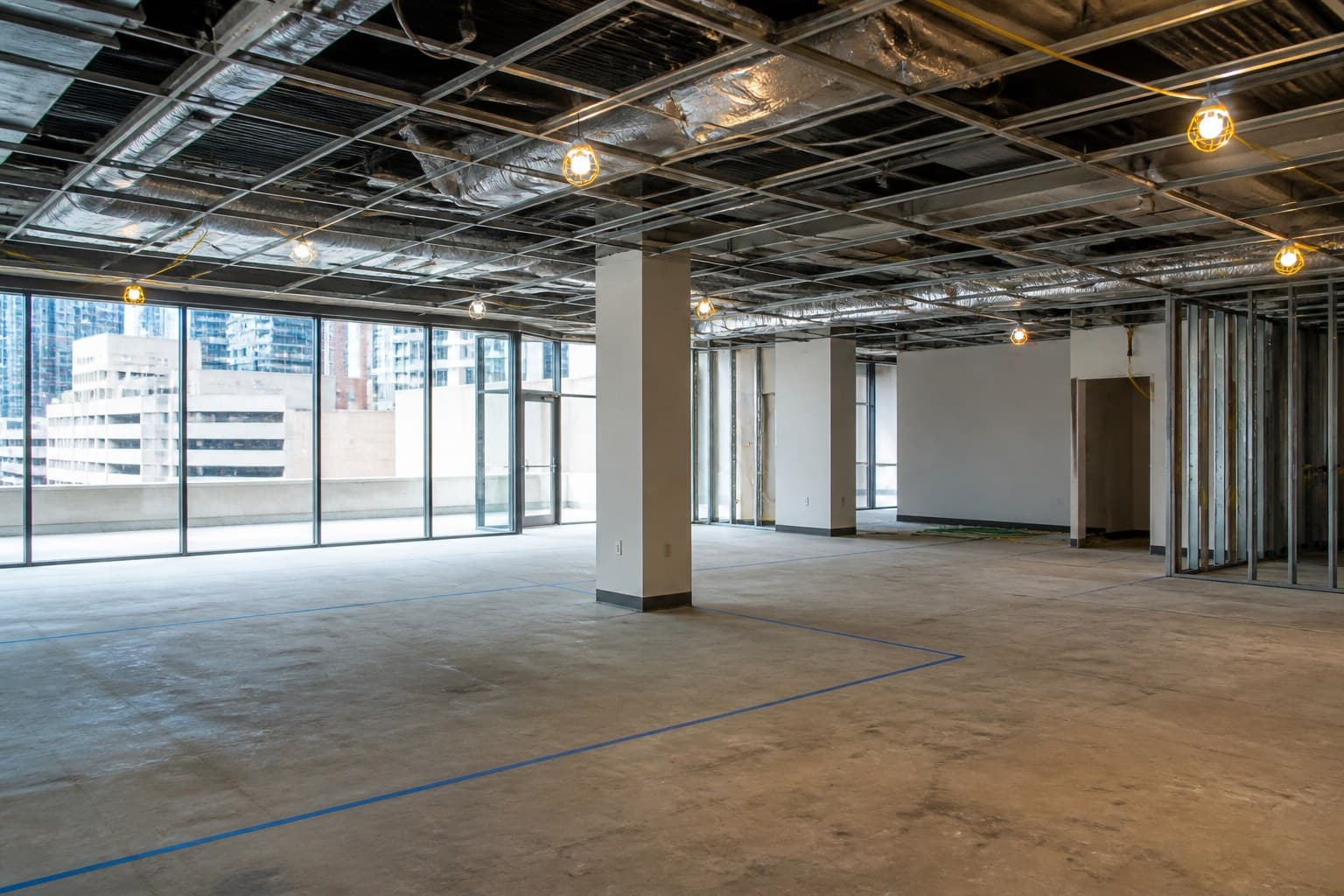

The contractor with the longest resume might be the worst choice for your 2025 tenant improvement project. While Denver's commercial real estate market races ahead with AI-driven project management and prefabricated systems, many veteran contractors are falling behind—and their outdated methods are costing property investors thousands in avoidable delays.
Why the "Most Experienced" Denver TI Contractor is Your Biggest Risk in 2025

Experience matters, but not the way you think.
A contractor who's spent 20 years doing things the same way isn't equipped for the modern tenant improvement landscape. 47% of commercial contractors now using Building Information Modeling report 15-25% reduction in rework, according to Dodge Data & Analytics. That's not a minor improvement—it's the difference between finishing on schedule and blowing your lease-up timeline.
The gap shows up in the numbers. Traditional TI projects in Denver Class A office space average 14-18 weeks. Technology-integrated projects? 10-13 weeks for the same 5,000-10,000 square foot spaces. When every week of downtime costs you potential rental income, that four-week difference translates to real money.
Here's what separates modern contractors from dinosaurs: predictive analytics and clash detection. AI-driven systems identify 70-85% of MEP conflicts before installation versus 30-40% with traditional 2D coordination. Stanford's Center for Integrated Facility Engineering found that predictive analytics reduced unforeseen conflicts by 40-52%.
Denver implemented digital plan review in 2023, cutting review cycles from 15-20 business days to 7-12 days for electronic submissions. If your contractor isn't submitting digitally and leveraging these systems, they're adding two weeks to your timeline for no reason.
Prefabricated and modular systems are reshaping commercial interiors. Modular partition systems reduce on-site construction time by 30-50% compared to stick-built methods. Demountable partition systems install 40-60% faster than traditional drywall. But contractors stuck in old patterns don't know how to bid these systems or coordinate them effectively.
At Autotelic, we've integrated BIM 360 into every commercial project. Our commercially licensed team manages everything from MEP coordination to final inspections through cloud-based platforms that give you real-time visibility. No surprises, no excuses.

The bottom line: Colorado's modular construction adoption is growing 18-22% annually. Contractors who haven't adapted are falling further behind every month.
Ditch the Lowest Bid—It's Secretly Inflating Your TI Costs by 50%

Low bidders win projects, then bleed you dry with change orders.
The pattern repeats across Denver's commercial market: A contractor comes in 20% below everyone else, wins the job, then hits you with modifications, material substitutions, and scope "clarifications" that push the final cost 15-25% over their original number. FMI Corporation research shows low-bid projects average 2.5-3.5x more change orders than negotiated contracts.
Material costs aren't stable anymore. RSMeans data shows commercial construction materials in Denver increased 4.2% year-over-year through 2024. The Associated General Contractors predicts 6-12% increases for 2025, driven by steel, electrical components, and HVAC equipment. Low bidders know this—they're just betting you won't notice until you're locked in.
Here's how the math actually works:
A contractor bids $150,000 for your buildout. They low-ball materials, underestimate labor, and skip contingencies. Three weeks in, steel prices jump. Your mechanical contractor discovers conflicts the GC should have caught. Change orders start flowing: $12,000 here, $8,000 there. Six months later, you've spent $195,000.
Meanwhile, the mid-tier bidder at $180,000 included proper contingencies, used accurate material pricing, and coordinated trades thoroughly. Their final invoice? $182,000.
**You didn't save money.

You paid a 15% premium for stress and delays.**
Value engineering beats low bidding every time. Formal value engineering studies produce average savings of 5-15% while maintaining or improving performance. The difference: value engineering happens upfront, not as damage control.
Prefabricated systems cost 10-15% more in materials but deliver 30-45% reduction in installation labor. Net result: 8-18% overall savings on affected systems. Low bidders won't propose these options because they require different supplier relationships and installation expertise.
LEED-certified commercial interiors cost 2-4% more upfront according to USGBC studies, but deliver 8-15% reduction in annual operating costs. They also command 4-8% rental premiums and see 7-12% higher tenant retention. That's not spending—it's investment.
Denver's Energize Denver program offers rebates up to $75,000 for commercial TI projects meeting energy efficiency targets. But you need a contractor who knows how to design for these incentives from day one, not retrofit them later.
Autotelic's approach: transparent, value-engineered proposals that include lifecycle costs, not just installation numbers.

Our two decades serving Denver's commercial market taught us that the lowest bid rarely delivers the lowest total cost of ownership.
Smart Tech Isn't Optional—Skip It and Your Denver Space Obsoletes in 2026

Tenants won't lease spaces that feel like 2015.
73% of corporate tenants prioritize buildings with advanced HVAC controls and air quality monitoring in their lease decisions, according to CBRE's 2024 survey. JLL found that 68% list smart building technology as "important" or "very important." This isn't future-thinking—it's current market reality.
The financial impact is measurable. Smart building features correlate with 12-18% faster lease-up times in competitive markets. McKinsey research shows these systems increase asset value by 3-5% in Class A properties. Buildings with advanced automation command 7-17% rental premiums.
Basic occupancy sensors cost $0.75-1.50 per square foot. Wireless HVAC zone controls run $2.50-4.50 per square foot. Integrated lighting control systems cost $3.00-6.50 per square foot. These aren't luxuries—they're baseline expectations for quality commercial space.
The energy savings justify the investment immediately. Occupancy-based HVAC controls reduce energy consumption by 18-30% in commercial spaces, according to ASHRAE research. Lutron's commercial case studies show advanced lighting controls with daylight harvesting achieve 28-40% lighting energy reduction.
In Denver's climate zone, the Rocky Mountain Institute calculates smart building systems deliver average annual savings of $1.20-2.40 per square foot. On a 10,000-square-foot tenant improvement, that's $12,000-24,000 per year. The payback period is typically under three years.
Hybrid work changed everything. Gensler's 2024 Workplace Survey found 82% of companies implementing hybrid models require flexible space booking and occupancy tracking systems. Without these tools, you're offering obsolete space to modern tenants.
Current wireless protocols matter. BACnet/IP is the industry standard for HVAC integration. Zigbee and Thread provide low-power mesh networks for sensors at $40-120 per device. Wi-Fi 6E handles high-bandwidth building systems at $150-350 per commercial-grade access point.
As a Crestron, Lutron, and Savant certified integrator, Autotelic designs commercial spaces where technology actually works together. We're not bolting on smart features as afterthoughts—we're designing integrated systems that enhance property value from day one.

Buildings without this infrastructure will face expensive retrofits or declining tenant quality. The 15-22% higher lease renewal rates smart buildings achieve aren't accidents—they're the result of giving tenants what they actually want.
Green Credentials Trump Speed—Non-Sustainable Contractors Face 2026 Denver Compliance Headaches

Denver's energy codes are tightening, and contractors who ignore sustainability are creating future liabilities.
The Denver Building and Fire Code adopted in December 2023 bases requirements on the 2021 International Energy Conservation Code with Colorado amendments. Commercial buildings must meet HVAC efficiency minimums of 14 SEER2 for split systems under 65,000 BTU/h. Lighting power density caps at 0.78-1.05 watts per square foot depending on space type.
The Energize Denver Ordinance requires buildings over 25,000 square feet to report energy use and meet performance standards. Office buildings target Energy Use Intensity of 50-65 kBtu per square foot per year. Retail targets run 85-110 kBtu per square foot per year.
Colorado's GHG Pollution Reduction Roadmap mandates 50% emissions reduction by 2030 from 2005 baseline levels, with 90% reduction by 2050. Denver's Climate Action Plan aims for net-zero emissions by 2040 for all buildings. These aren't suggestions—they're regulatory requirements your contractor needs to understand.
Material specifications matter more than ever. Carpet with 25-35% post-consumer recycled content. Ceiling tiles with 65-85% recycled content. Low-VOC paints under 50 g/L. Adhesives under 70 g/L for carpet applications. These specifications affect your permitting timeline and compliance status.
Solar-ready design requirements include roof load capacity and conduit pathways. The typical cost for solar-ready infrastructure coordination is $0.25-0.75 per square foot of building area. Include it now or pay for complex retrofits later.
The federal 179D Commercial Buildings Energy Efficiency Tax Deduction offers up to $5.00 per square foot for buildings meeting 25% energy savings thresholds. Lighting-specific deductions run $0.60-1.20 per square foot. Xcel Energy commercial rebates provide $50-200 per kW for lighting and $150-400 per ton for HVAC.
Typical TI rebate potential ranges from $2.00-8.00 per square foot depending on measures implemented. These incentives turn green building from a cost center into a revenue opportunity—but only if your contractor knows how to design for them from the start.

Non-compliance carries real penalties. Energize Denver fines reach up to $500 per day for failure to report or meet performance standards, with an escalating structure. Stop-work orders cost $5,000-50,000 in delay expenses. Permit revocations require complete redesign and resubmission.
LEED certification fees run $2,000-8,000 depending on project size. Green building consultant fees range from $5,000-25,000 for TI projects. But the net cost premium for LEED Silver in tenant improvements is just 0-3% according to 2024 industry consensus. You're paying for certification and documentation, not drastically different construction methods.
Autotelic serves as a Tesla Solar Roof and Powerwall certified installer, giving us unique expertise in integrating renewable energy systems with commercial construction. We design tenant improvements that meet today's codes while preparing for tomorrow's requirements.
Forget Reviews—This One Denver-Specific Checklist Vets Winners Instantly
Google reviews don't tell you what matters for commercial tenant improvements.
Denver's permitting process operates differently than surrounding jurisdictions, and contractor familiarity with these specific requirements saves months. Category I simple commercial TI permits take 7-14 business days. Category II complex permits need 15-30 business days. Projects requiring Design Review Board add 6-12 weeks. Historic district approvals add 4-8 weeks minimum.
Top-performing contractors get through permitting 20-30% faster than city averages because they know exactly what Denver's Community Planning and Development reviewers expect. They submit complete drawings the first time. They understand Denver's fire protection and accessibility provisions that exceed base IBC requirements.
Lower Downtown's Landmark Preservation Commission adds 30-45 days minimum for exterior alterations and storefront modifications. Cherry Creek North design review runs 20-30 days for commercial frontages. Contractors without experience in these districts will stumble through processes that specialists navigate smoothly.
Labor shortages are hitting Denver hard. 89% of Colorado contractors report difficulty filling positions according to AGC's 2024 workforce survey. Licensed electricians and HVAC technicians face shortage severity ratings of 8-8.5 out of 10. These shortages are adding 2-4 weeks to typical TI timelines—a 15-20% increase.
Smart contractors maintain strong trade relationships and crew stability. They're not scrambling to find subcontractors mid-project or accepting whoever's available. Ask for their electrician's name and how long they've worked together. Vague answers mean trouble.
Here's your Denver TI contractor checklist:
License and Insurance Requirements:
- Colorado Commercial General Contractor License (required for projects over $500,000)
- Denver Business License current
- Trade-specific licenses for all subs (electrical, plumbing, HVAC)
- General liability coverage of $2M-5M aggregate
- Professional liability of $1M-2M for design-build work
- EMR (Experience Modification Rate) under 1.0
Denver-Specific Performance Metrics:
- First-submission permit approval rate above 75%
- Average permit processing time vs. city baseline
- Experience with historic district approvals if relevant
- Track record with Denver's 2023 Building and Fire Code amendments
- Understanding of Denver's Seismic Design Category C requirements
Project Management Capabilities:
- BIM 360 or equivalent cloud-based coordination
- Digital plan submission and review processes
- Predictive analytics for scheduling
- Change order rate under 5% of contract value
- Real-time project tracking and client visibility
Sustainability Expertise:
- Energize Denver program knowledge
- Federal 179D tax deduction experience
- LEED project history and certification process familiarity
- Low-carbon material sourcing relationships
- Energy modeling capabilities
Verify everything through public records. Denver CPD's permit history is searchable by contractor name. Violation and stop-work order history is available. Colorado's DORA maintains license verification and disciplinary action records online.
For multi-site rollouts, prototype designs reduce permitting time by 30-50% for subsequent locations. Contractors who understand this can coordinate simultaneous submissions across Denver's metro jurisdictions—each with unique code amendments and processes.
Autotelic holds a commercial contractor license and maintains all trade-specific licensing in-house. Our 20+ years serving Denver's commercial market means we know the reviewers, understand the local requirements, and move projects through permitting without surprises.
Ready to Get Started?
Your commercial tenant improvement deserves a contractor who understands both construction fundamentals and 2025 market realities. Autotelic combines two decades of Denver commercial experience with cutting-edge project management technology, smart building integration expertise, and deep knowledge of local permitting processes.
We're a veteran-owned (USMC), commercially licensed general contractor with certified capabilities in Crestron, Lutron, Savant smart systems and Tesla Solar + Powerwall integration. Our vertically integrated approach means you work with one team from design through final occupancy—no finger-pointing, no coordination gaps.
Contact Autotelic today for a consultation on your next commercial tenant improvement project. Let's build something that attracts premium tenants and performs for decades.
Related Reading & Recent Work
- Commercial Tenant Finish & Build-Outs — our TI service
- Parker Powersports — full dealership tenant finish — raw shell to opening day